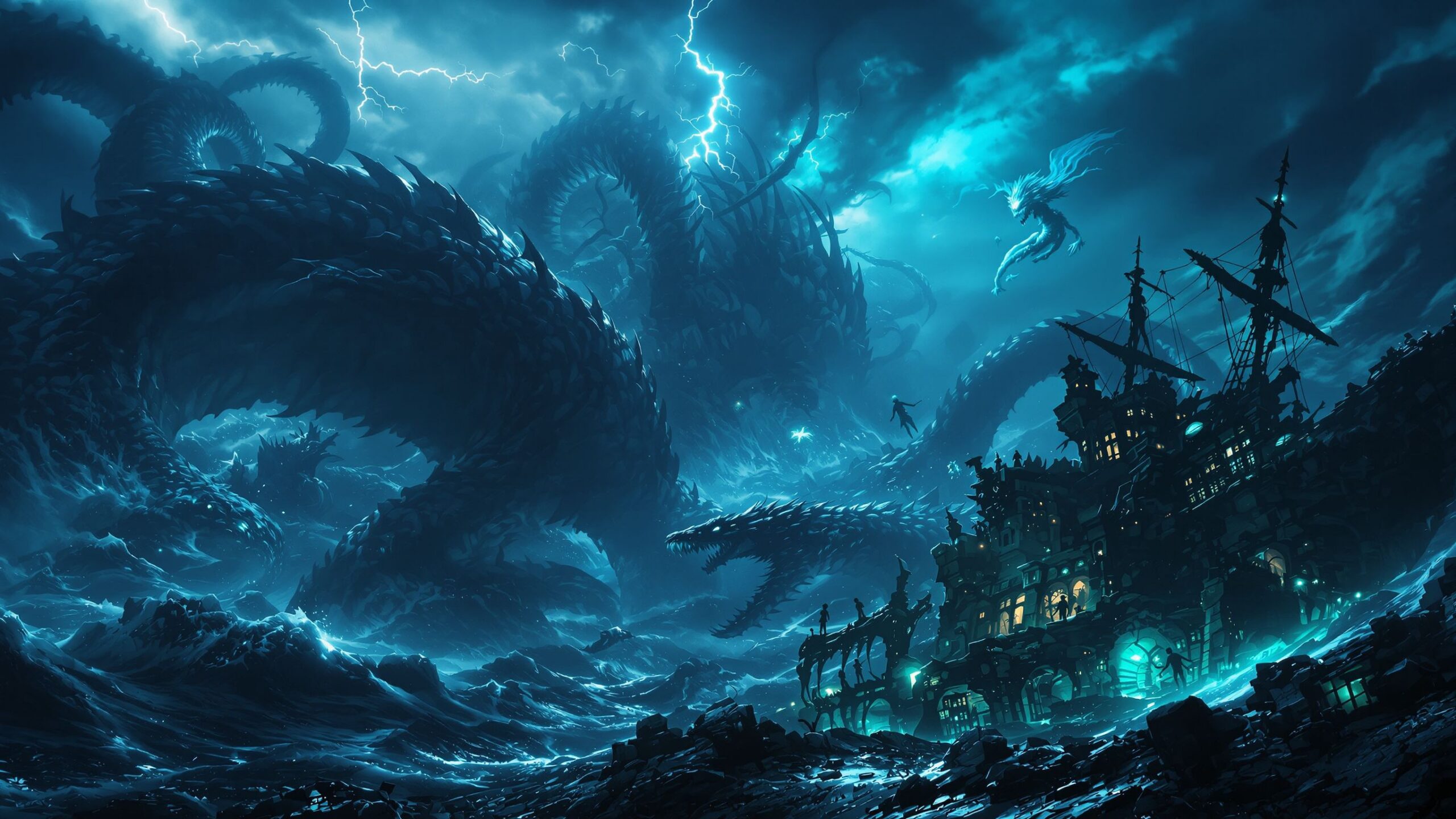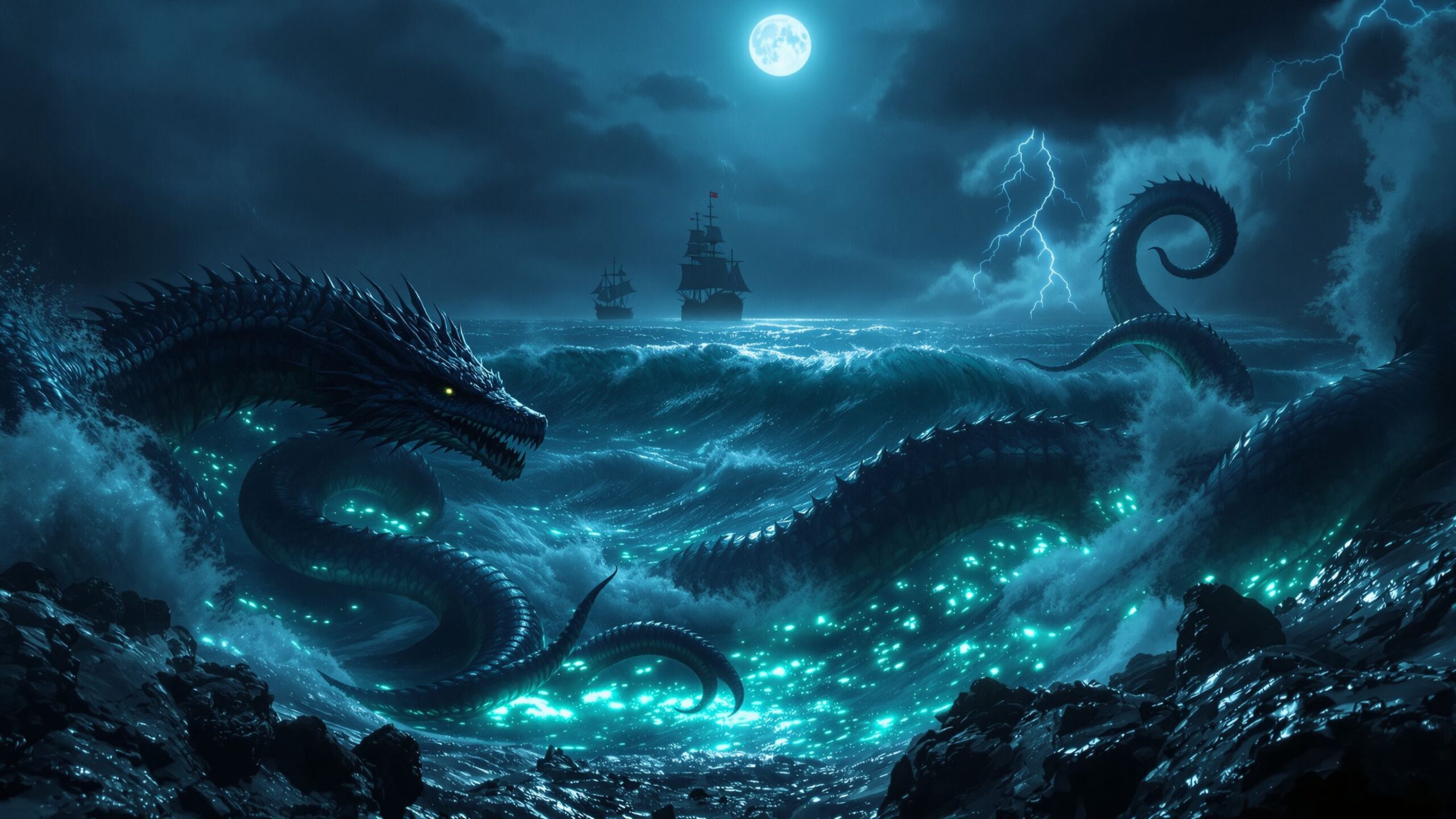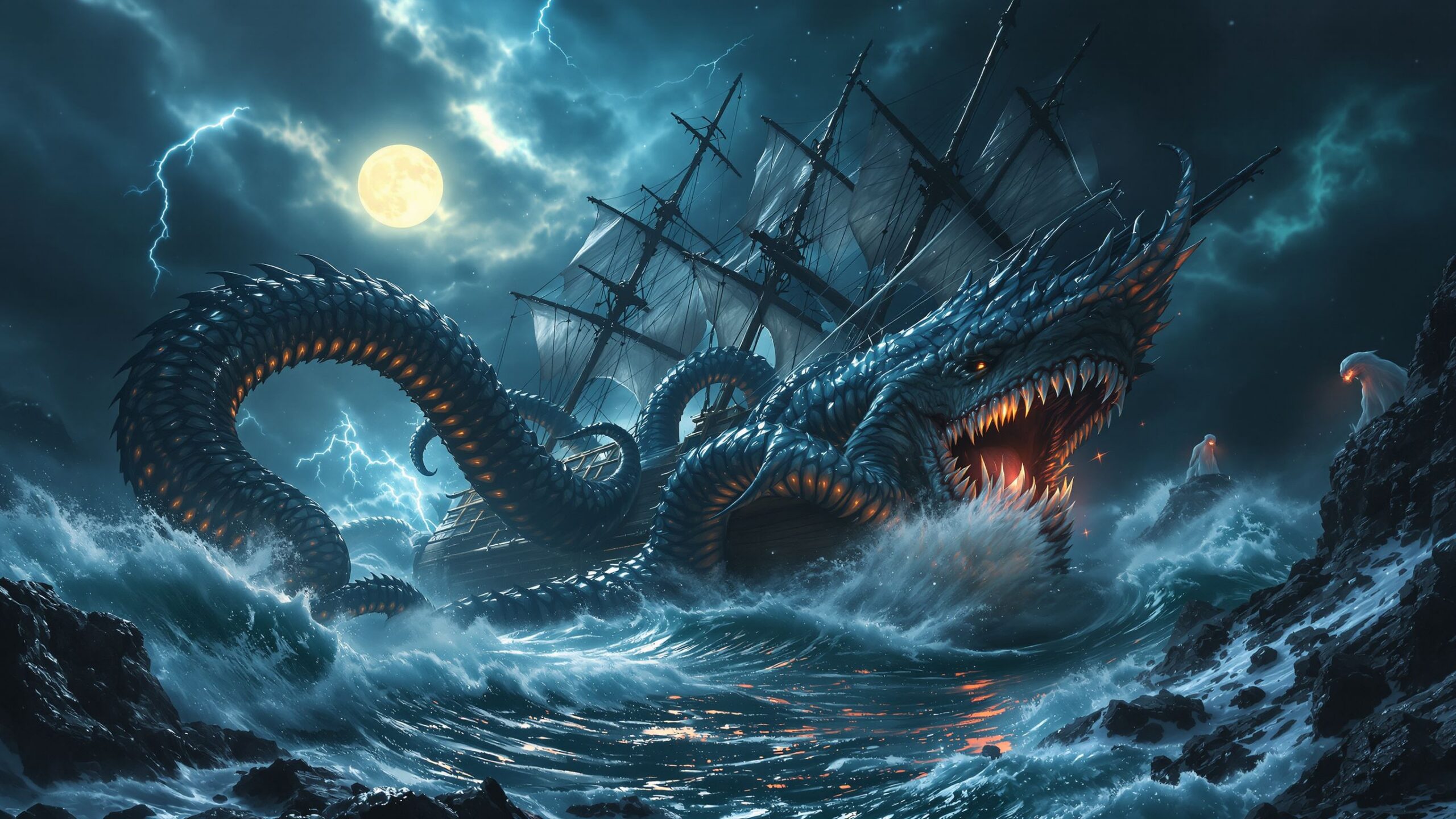
For thousands of years, the world’s oceans have inspired stories of enormous monsters hiding beneath the waves. Ancient sailors crossed vast stretches of water without modern navigation, weather forecasting, or scientific knowledge, leaving them vulnerable to storms, strange marine animals, and unexplained events. Whenever ships disappeared or mysterious creatures appeared on the horizon, legends quickly followed. These tales became some of history’s most enduring myths, transforming ordinary voyages into terrifying adventures filled with giant serpents, monstrous squid, ghostly spirits, and dragon-like beasts. Although science has explained many natural phenomena that once seemed supernatural, the legends surrounding famous sea monsters continue to capture imaginations because much of the ocean remains unexplored. Even today, the mysteries of the deep make it easy to understand why these incredible stories have survived for centuries.
A: The Kraken is widely considered the world's most famous legendary sea monster.
A: Unexplored oceans, storms, giant marine animals, and mysterious disappearances fueled these beliefs.
A: Many historians believe giant squid sightings helped inspire the Kraken legend.
A: Leviathan is an enormous sea creature appearing in ancient religious tradition and mythology.
A: Yes. Sea serpent legends exist throughout Europe, Asia, the Americas, and many island nations.
A: The deep ocean remains mysterious, leaving room for imagination and legend.
A: Many medieval and Renaissance maps included illustrations of legendary sea creatures.
A: Not usually. Lake monsters belong to freshwater legends, while sea monsters are associated with oceans.
A: Whales, giant squid, oarfish, storms, rogue waves, and sailor storytelling likely influenced many legends.
A: They combine history, mythology, mystery, and humanity's fascination with the unknown depths of the ocean.
Why Sea Monster Legends Have Endured
Unlike many mythical creatures, sea monsters were believed to exist in places few people could explore. The open ocean was unpredictable, dangerous, and filled with unfamiliar life forms that often appeared enormous or frightening. Giant whales, colossal squid, schools of fish, and massive waves could easily be mistaken for something supernatural, especially during violent storms or poor visibility. Every sailor returned with a different story, allowing legends to grow larger and more terrifying with each generation. As exploration expanded across the globe, nearly every maritime culture developed its own terrifying creatures lurking beneath the waves.
The Kraken
No sea monster is more famous than the Kraken. Originating in Scandinavian folklore, this colossal creature is usually portrayed as an enormous squid or octopus capable of attacking entire ships. Legends describe giant tentacles rising from the sea, wrapping around wooden vessels before dragging them into the depths. Sailors also believed the Kraken created powerful whirlpools as it surfaced, making escape nearly impossible. Although giant squid were eventually discovered and proven to exist, they are far smaller than the legendary beast described in folklore. Even so, the Kraken remains the ultimate symbol of oceanic terror.
Leviathan
The Leviathan is one of history’s oldest and most powerful sea monsters. Appearing in ancient religious texts and Middle Eastern mythology, the Leviathan is commonly described as a gigantic dragon-like sea serpent covered in nearly impenetrable scales. Its immense body was believed to churn the oceans into violent storms while its enormous jaws could swallow almost anything in its path. Throughout history, the Leviathan has represented the overwhelming strength and unpredictability of nature, becoming a lasting symbol of chaos beneath the sea.
Sea Serpents
Sea serpent legends appear in cultures around the world, making them among history’s most widespread monster stories. Witnesses often described creatures stretching hundreds of feet in length with long snake-like bodies rising dramatically from the ocean surface. Sailors reported seeing enormous humps moving through the water before massive heads emerged beside their ships. While many sightings were likely caused by whales, giant eels, or unusual wave patterns, sea serpent reports have continued for centuries and remain one of maritime history’s greatest mysteries.
Scylla
Greek mythology introduced one of the most terrifying sea monsters ever imagined in Scylla. Hidden among dangerous coastal cliffs, Scylla possessed multiple snapping heads, razor-sharp teeth, and long necks capable of reaching passing ships. Sailors attempting to avoid her deadly attacks often found themselves drifting dangerously close to another terrifying threat nearby. Her legend symbolized the deadly hazards of navigating narrow waterways where hidden rocks and strong currents could easily destroy a vessel.
Charybdis
Located opposite Scylla in Greek mythology, Charybdis took the form of a gigantic whirlpool rather than a traditional creature. Several times each day, she was said to swallow massive amounts of seawater before violently releasing it again, creating enormous currents capable of consuming entire ships. Ancient mariners dreaded becoming trapped between Scylla and Charybdis, a situation that inspired the well-known expression describing a choice between two equally dangerous outcomes.
Sirens
Among the most haunting sea monsters of ancient mythology are the Sirens. Originally portrayed as bird-like beings before evolving into mermaid-like figures, Sirens used enchanting songs to lure sailors toward rocky coastlines where their ships would crash. Their irresistible voices represented temptation, distraction, and hidden danger. Stories of sailors struggling to resist the Sirens’ haunting melodies have remained popular for thousands of years and continue inspiring books, films, and modern fantasy.
The Loch Ness Monster
Although technically inhabiting a freshwater lake rather than the open ocean, the Loch Ness Monster has become one of the world’s most famous aquatic creatures. Witnesses describe a massive animal with a long neck emerging from Scotland’s dark waters before disappearing beneath the surface. Reports date back hundreds of years, and despite extensive sonar surveys, underwater investigations, and DNA studies, no conclusive evidence has explained every claimed sighting. Nessie remains one of history’s greatest unexplained mysteries.
Umibōzu
Japanese sailors have long feared the mysterious Umibōzu, a towering black sea spirit said to emerge suddenly from calm waters. Witnesses describe an enormous shadowy figure with a smooth head rising silently beside ships before demanding a bucket from terrified crews. According to legend, giving the spirit a bucket allows it to flood the vessel until it sinks beneath the waves. The Umibōzu reflects the unpredictable nature of the ocean, where peaceful seas can become deadly in moments.
The Ningen
One of the most unusual modern sea monster legends is the Ningen, a mysterious humanoid creature reportedly living in the icy waters surrounding Antarctica. Witnesses describe an enormous pale being with long arms, smooth white skin, and a vaguely human appearance. Although blurry photographs and stories have circulated for years, scientists have found no evidence supporting its existence. Nevertheless, the Ningen has become one of the most fascinating additions to modern sea monster folklore.
Why Sea Monsters Continue to Fascinate Us
Sea monster legends have endured because the oceans remain among Earth’s least explored environments. Scientists estimate that much of the deep sea has never been thoroughly studied, leaving countless species still waiting to be discovered. Every expedition reveals bizarre creatures unlike anything previously imagined, from glowing fish and giant squid to transparent predators living in total darkness. These discoveries remind us that the ocean still contains extraordinary mysteries, making ancient sea monster legends feel surprisingly believable.
Modern entertainment has also helped preserve these stories. Movies, television series, novels, documentaries, and video games continue introducing legendary sea monsters to new audiences. While many viewers understand these creatures belong to mythology, the excitement surrounding them never fades because the possibility of discovering something unknown beneath the waves continues to inspire curiosity.
Conclusion
The most famous sea monsters in history have remained legendary because they combine humanity’s oldest fears with the endless mystery of the ocean. The Kraken, Leviathan, giant sea serpents, Scylla, Charybdis, Sirens, the Loch Ness Monster, Umibōzu, and the Ningen each represent different cultures and traditions, yet all remind us of the incredible power and uncertainty hidden beneath the sea. Although science has explained many ancient mysteries, much of the world’s oceans remains unexplored, leaving room for wonder and speculation. As long as deep waters continue concealing their secrets, legendary sea monsters will remain an unforgettable part of history, mythology, and human imagination.