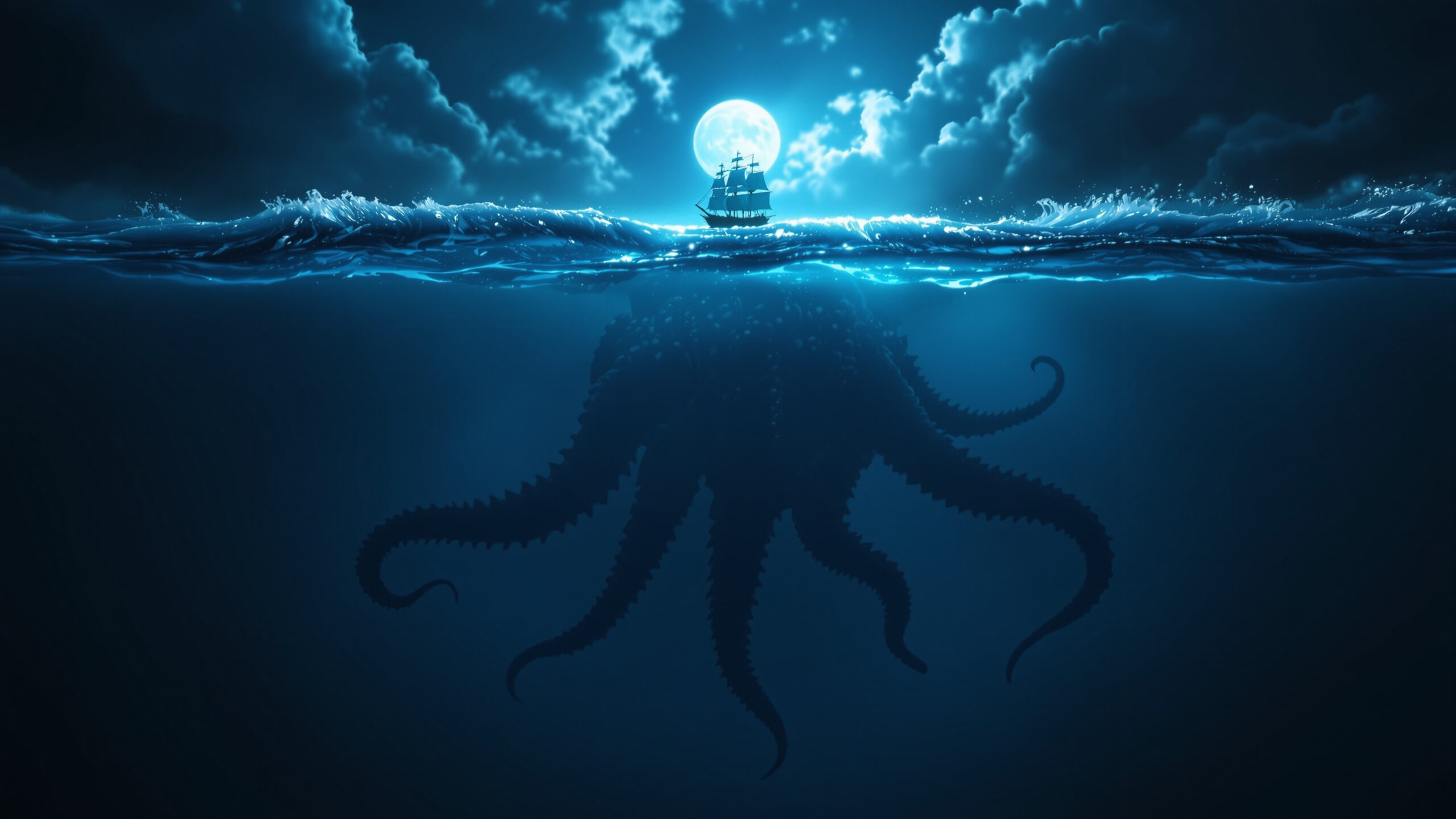
The ocean is Earth’s largest and least explored environment, a vast and crushing world where sunlight disappears within the first few hundred feet and pressure reshapes reality itself. More than eighty percent of the ocean remains unmapped, unseen, and untouched, creating the perfect conditions for mystery. It is within these dark, silent depths that stories of aquatic monsters have persisted for centuries. Unlike land-based cryptids, oceanic monsters benefit from an environment where concealment is natural and discovery is rare. Every deep-sea expedition uncovers creatures that look alien to human eyes, reinforcing the unsettling idea that even larger, stranger beings may still exist beyond our reach.
A: The deep is genuinely under-observed; low light, pressure limits, and rare access make “unknown” plausible.
A: Yes—layers, schools, bottom contours, and noise can create strange returns, especially near thermoclines.
A: Large squid, oarfish, whales, basking sharks, deep-sea fish seen at the surface, and debris fields in rough seas.
A: Particles in water, limited light, motion, and narrow beams turn big shapes into abstract shadows fast.
A: Multiple data points: visual + sonar + time/location logs + consistent witness notes made immediately afterward.
A: Not necessarily—many animals signal or camouflage with light, but unusual, coordinated patterns fuel speculation.
A: It can be perception under stress, but predators can change local behavior—silence is also easier to notice at sea.
A: They’re mysterious and hard to study, but food is sparse; most large animals still rely on productive zones nearby.
A: Record time/coords, sea state, sensor settings, and write separate witness notes before discussing details as a group.
A: We’ll learn more with better ROVs, sensors, and surveys—but the deep will likely keep some mysteries for a long time.
Ancient Sea Serpents and Maritime Terror
Long before modern science, sailors recorded encounters with enormous serpent-like creatures rising from the waves. These sea serpents were described as impossibly long, with coils that wrapped around ships and heads that towered above masts. Ancient maps often labeled unknown waters with warnings and illustrations of monstrous beings, not merely as decoration but as genuine navigational fear. Some historians argue these sightings were exaggerations of whales or oarfish, yet many descriptions include features such as maned necks, reptilian heads, and coordinated movements that do not align with known marine animals. The consistency of these reports across cultures suggests something more than imagination shaped by isolation and fear.
The Kraken and the Crushing Deep
Among the most feared oceanic monsters is Kraken, a colossal cephalopod said to drag entire ships beneath the waves. Originating in Norse legend, the Kraken was long dismissed as myth until the discovery of the giant squid challenged scientific assumptions. Modern giant squids reach lengths exceeding forty feet, live at extreme depths, and possess enormous eyes adapted for darkness. These revelations forced researchers to reconsider whether historical Kraken sightings were distorted encounters with real animals or evidence of something even larger still lurking in the abyss. The ocean’s depth allows massive creatures to remain hidden, surfacing only briefly and rarely, reinforcing the Kraken’s enduring legend.
Giant Squid Sightings and Unanswered Questions
The confirmation of the giant squid did not end the mystery, but expanded it. For centuries, sailors reported battles between tentacled monsters and whales, stories that scientists dismissed as folklore. Today, scars on sperm whales match giant squid suction cups, validating those early accounts. Yet many sightings describe creatures far larger than any documented specimen, with thicker limbs, longer bodies, and aggressive behavior inconsistent with known squid. Deep-sea footage has captured glimpses of massive shapes moving just beyond the range of light, hinting that the largest cephalopods may still be unknown to science.
The Darkness of the Abyssal Zone
Below 13,000 feet lies the abyssal zone, a realm of total darkness, extreme pressure, and near-freezing temperatures. Life here evolves in isolation, adapting in ways that challenge human understanding. Bioluminescent predators, transparent organisms, and creatures with enormous mouths already exist in this environment. Given these realities, the idea of undiscovered aquatic monsters becomes less far-fetched. Some deep-sea submersible pilots have reported enormous silhouettes moving at the edge of sonar range, too large and too fast to identify. These encounters are often classified or dismissed due to lack of visual confirmation, yet they leave lasting impressions on those who witness them.
Modern Naval Encounters at Sea
Unlike ancient legends, some of the most compelling aquatic monster reports come from modern naval and commercial vessels. Crews have described massive underwater objects pacing ships, moving faster than submarines, and vanishing into the depths without leaving turbulence. Sonar readings occasionally detect objects of extraordinary size that defy classification. While military explanations often cite equipment malfunctions or unidentified natural phenomena, the repetition of these events across different oceans suggests a persistent anomaly. The ocean’s vastness makes it difficult to rule out unknown biological explanations, especially in regions rarely explored by humans.
Monsters of the Midwater Realm
Not all aquatic monsters are believed to dwell on the ocean floor. Some sightings occur in the midwater zone, where creatures migrate vertically and remain hidden in darkness during the day. Witnesses report massive eel-like beings with glowing eyes and undulating movement, often appearing briefly before disappearing downward. These encounters are frequently reported by deep-sea fishermen and submersible crews who are familiar with known marine life, making misidentification less likely. The midwater realm remains poorly studied, leaving room for creatures that evade nets, cameras, and classification.
The Bloop and Unexplained Ocean Sounds
In 1997, underwater microphones detected a powerful low-frequency sound known as the Bloop. The noise was louder than any known animal and originated from the depths of the Southern Ocean. While scientists later suggested ice-related explanations, the sound’s biological characteristics initially puzzled researchers. The idea that a living creature could produce such an intense signal reignited speculation about massive deep-sea life forms. Though officially explained, the Bloop remains a symbol of how little we truly know about the sounds and movements occurring in Earth’s oceans.
Ancient Creatures Thought Extinct
The discovery of the coelacanth, a fish believed extinct for millions of years, reshaped scientific thinking about ocean life. This living fossil proved that large vertebrates could survive undetected in deep waters. Its discovery raises an unsettling question: if one ancient species endured unnoticed, how many others might still exist? Some aquatic monster theories propose surviving prehistoric reptiles or massive fish that adapted to deep-sea conditions. While extraordinary claims require extraordinary evidence, history has shown that the ocean is capable of hiding the extraordinary for astonishing lengths of time.
Why the Ocean Hides Its Monsters
The ocean is uniquely suited to conceal life. Extreme pressure limits exploration, darkness obscures vision, and vast distances prevent comprehensive surveys. Even advanced technology struggles in deep-sea environments, where equipment failures are common and observation windows are brief. Aquatic monsters, if they exist, would be perfectly adapted to these conditions, surfacing rarely and avoiding human detection. Unlike land animals, they leave no tracks, no bones easily recovered, and no consistent physical evidence.
The Psychological Power of the Deep
Human fear of aquatic monsters is deeply rooted in the unknown. The ocean represents a place where humans are physically vulnerable and technologically limited. Stories of massive creatures lurking below the surface tap into primal anxieties about depth, darkness, and isolation. This psychological element does not invalidate sightings, but it complicates interpretation. Fear can sharpen perception just as easily as it can distort it, making each encounter difficult to evaluate with certainty.
Science, Skepticism, and Open Questions
Skeptics argue that aquatic monster sightings are the result of misidentified whales, sharks, or optical illusions amplified by stress and darkness. While many reports can be explained this way, others resist easy dismissal. Science thrives on questioning assumptions, and the ocean continues to challenge them. Each new species discovered at depth reinforces the idea that knowledge is incomplete. The line between skepticism and curiosity remains thin, especially in an environment as mysterious as the deep sea.
A World Still Unexplored
Aquatic monsters persist in human imagination because the ocean remains largely unexplored. With every expedition, new life forms are discovered that would have once been considered impossible. Whether the monsters of legend are undiscovered animals, exaggerated encounters, or something stranger altogether, their stories endure because the environment that might hide them still exists. Until the deepest parts of the ocean are fully explored, aquatic monsters will remain one of the most compelling and unsettling mysteries on Earth.