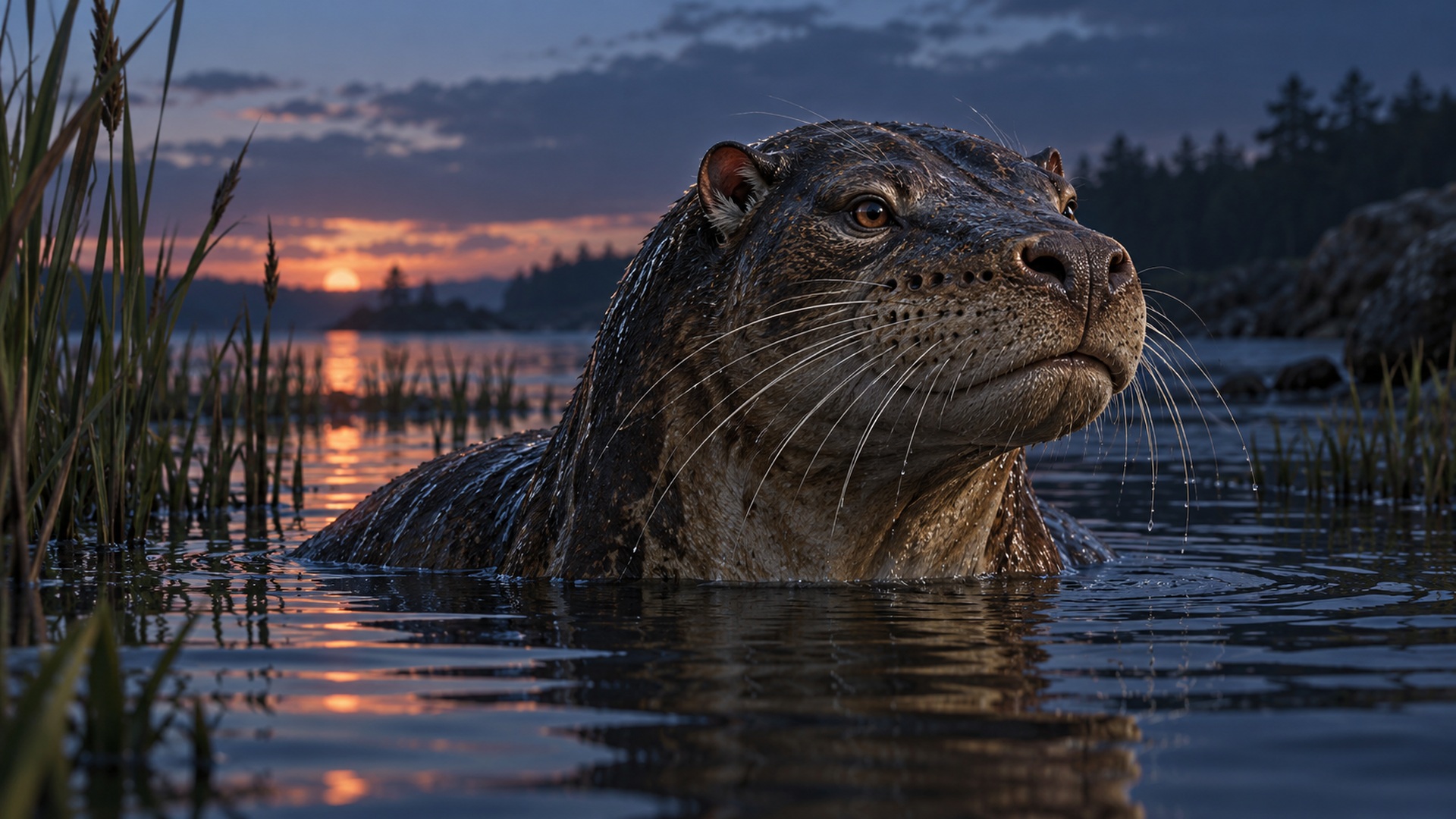
The Same Shoreline Can Contain Several Different Worlds
At dusk, a shoreline becomes difficult for human eyes to read. A shape disappears into shadow, an unseen movement disturbs the reeds, and a sound arrives from somewhere beyond the water. Another animal might receive a very different account of the same scene. It could follow odor, interpret echoes, register nearby water motion, or detect thermal contrast that contributes information ordinary vision misses. A fictional monster can draw on those biological possibilities, but adding exceptional senses does not make it omniscient. Every sensory system requires a physical signal, a suitable receptor, and a way to interpret incomplete evidence. Habitat determines which signals travel well, while noise and obstacles limit what they reveal. Exploring sight, smell, sound, and less familiar channels therefore offers more than a menu of supernatural upgrades. It explains how a creature’s body and behavior could fit the information available around it, and why a powerful sense can remain impressive even when its limitations are clear.
A: No. A signal can be detectable while its source remains ambiguous.
A: It uses emitted signals and returning echoes to obtain information.
A: Specialized thermal sensing does not make arbitrary barriers transparent.
A: A new position can improve sensory sampling or resolve uncertainty.
A: Chemical traces can persist after their source moves elsewhere.
A: Transmission depends on the substrate and its connections.
A: It receives mechanical disturbances rather than light from a scene.
A: The source, medium, receptors, and interference constrain its usefulness.
A: Different cues can contribute complementary information or help resolve uncertainty.
A: Consistent responses to signals humans miss can establish a distinct sensory world.
Start With the Signal That Reaches the Animal
Sensing begins with a physical event that can affect a receptor. Light, pressure changes, chemical molecules, temperature-related radiation, and electric fields are different kinds of information carriers. A creature must have anatomy capable of responding to the relevant carrier. Declaring that it senses prey without identifying that connection leaves the most interesting part of the explanation unresolved.
The signal must also survive the journey. Distance, obstacles, absorption, scattering, and competing sources can reduce its usefulness. A receptor can be very sensitive without receiving enough reliable information to identify a target. This distinction helps keep exceptional senses grounded: the animal may detect a disturbance, then need to move or use another channel before it understands what is there.
Vision Balances Light, Detail, and Coverage
Eyes gather information from light, but no single visual design maximizes every capability under every condition. Light availability, spatial detail, field of view, color information, and the ability to handle changing brightness interact. An animal adapted to dim environments should not automatically be assumed to see equally well in all other situations. Its visual performance belongs to particular tasks and conditions.
Eye placement affects how a creature samples the scene. Different arrangements can favor broad coverage, overlapping views, or looking from a particular posture. A monster’s skull should therefore tell a story about where useful information comes from. Eyes near the top of a broad head may suit watching while most of the body remains concealed, whereas another design may favor looking ahead during rapid movement.
Movement and contrast can provide useful cues even when fine detail is unavailable. A prey animal may become noticeable against a bright opening without being clearly identified. Conversely, a motionless object can remain ambiguous despite being in view. These uncertainties let a visually capable monster behave intelligently without granting it a perfectly labeled picture of everything around it.
Smell Samples Chemicals in a Changing Medium
Odor depends on molecules reaching sensory structures and interacting with them. The information may indicate a substance, an animal, or a recent event, but its meaning depends on context and experience. Chemical traces can persist after a source has moved. A creature following them is therefore interpreting a changing record, not necessarily receiving the source’s current coordinates.
Air and water distribute chemicals differently, while turbulence and obstacles create uneven concentrations. Sampling from several positions can provide additional information that one sniff cannot. A fictional tracker might pause, move laterally, or return to a location where a trace was stronger. Those behaviors show the animal gathering evidence and make smell a distinctive sensory process rather than invisible long-range vision.
Hearing Extracts Events From Pressure Changes
Hearing can reveal activity when the source is hidden, but receiving a sound does not guarantee precise localization or identification. Reflections, barriers, background noise, and the frequency content of the signal influence what the animal can infer. Receptor anatomy and neural processing matter too. A monster may orient toward a disturbance and then need another cue to resolve it. That behavior is more informative than assuming every rustle produces an exact map, and it gives caves, forests, and buildings different acoustic character without requiring a different supernatural rule in every scene.
Follow One Hunter Across the Waterline
Imagine a creature following a riverbank animal from open water toward reeds. Underwater, its local flow receptors encounter disturbances from the target, the bank, and its own movement. As the head rises, airborne odors and sounds become available through a different medium. The animal pauses and reorients instead of receiving one unchanged sensory display through the transition. That behavior tells us which information it is seeking now.
Its organs also need protection and appropriate working conditions. A sensitive exposed surface may face abrasion on a dry bank, while a water-specialized receptor cannot simply supply the same information in air. Complementary senses let the hunter change tactics: a lift of the nose, a period of stillness, or a turn toward a sound can replace the earlier underwater sampling. The transition gives the creature a clear advantage in one setting and a period of uncertainty in another. Its sensory abilities become part of its daily movement rather than an unlimited list that follows it unchanged everywhere.
Echolocation Creates Its Own Sampling Opportunity
An echolocating animal emits a signal and interprets returning echoes. The outgoing sound provides a known event against which delays and other echo features can be compared. This is different from listening only to sounds made by prey. The creature participates actively in creating the information it receives, so changes in its emission can change the sensory task.
Nearby surfaces can return echoes that compete with those from a target. A forest, a cluttered cave, and open air therefore present different problems. Laura Stidsholt and colleagues’ 2021 Science Advances study, Hunting Bats Adjust Their Echolocation to Receive Weak Prey Echoes for Clutter Reduction, used recording tags on wild bats to examine changes in calling and flight around prey encounters. The important lesson for a monster is adaptability, not a claim that echoes deliver a flawless three-dimensional picture under all conditions.
An active signal can also have consequences for the emitter. Other animals capable of detecting it may gain information about the hunter, and producing and processing repeated calls requires a working biological system. A fictional echolocator can vary its behavior with context. Silence, a changed call pattern, or a shift in head orientation can become visible clues about what it is trying to learn.
Thermal Cues Need Specialized Anatomy and Contrast
Some animals detect infrared-related thermal information through specialized structures. Elena O. Gracheva and colleagues’ 2010 Nature paper, Molecular Basis of Infrared Detection by Snakes, identified a role for the heat-sensitive TRPA1 channel in specialized infrared-sensing anatomy. This is a real source of inspiration for creature design, but it should not be confused with ordinary eyesight receiving every wavelength of light.
The usefulness of thermal information depends on contrast, the geometry of the scene, and what lies between source and receiver. A warm surface is not automatically an animal, and an obstacle does not become transparent because the receiver is sensitive. A monster can use thermal cues to supplement other evidence while still facing ambiguity. Facial structures adapted to that channel should have a role consistent with the way the creature positions its head.
Touch and Vibration Turn Contact Into Information
Direct contact can provide detailed information about pressure, texture, and movement. Whiskerlike structures, sensitive skin, or specialized appendages can extend the animal’s sampling beyond the central body. Their value depends on what they touch and how the signals are processed. A structure that looks delicate may be sensory rather than decorative, but its sensitivity does not make it immune to damage.
Vibrations can travel through connected solids, although the usefulness of a disturbance depends strongly on the material and geometry. A branch, rock slab, loose soil, and building floor do not transmit every event identically. Several sources can overlap, and the receiver may need to distinguish background activity from a meaningful change. A monster with this ability should respond differently across substrates.
Contact-based sampling can influence posture and pace. The animal might place a sensory appendage before moving its main body, or pause while vibrations from its own movement settle. Such behavior gives the sense an operating rhythm. It also provides a believable reason why the creature sometimes seems more aware when still than when charging through a noisy environment.
A Fish’s Lateral Line Samples Local Water Movement
Many fishes have a lateral-line system containing small mechanosensory organs called neuromasts, located on the body surface or within canals. Movement of water relative to the fish deflects their sensory structures. Zebrafish are an important research example: the system gives biologists a way to study how a distributed set of receptors develops and responds to its surroundings. For a nearby hunter, the useful signal might arise from another animal moving through the water, but its own swimming and the surrounding current also contribute. This is local physical information, not a panoramic account of everything happening across a lake. An aquatic monster based on the idea would need a body posture and sampling routine that help separate a useful disturbance from the water motion it creates itself.
Electric Fields Offer a Specialized Aquatic Possibility
Electroreceptive animals respond to electric fields through specialized sensory systems. Sharks and rays provide familiar biological examples, but the mechanism is not a universal detector that can be assigned unlimited range. The surrounding medium and the characteristics of the source determine what information is available. A creature using this channel should be designed around the conditions that make it useful.
Weak biological fields and large artificial electrical sources also should not be treated as identical cues with the same meaning. Detecting an unusual field is not the same as identifying a specific living target. An aquatic monster could investigate, combine the signal with contact or chemical information, and sometimes make mistakes. Those limits preserve the difference between a specialized sense and a general power to know what is nearby.
Several Imperfect Channels Can Work Together
A predator need not obtain every answer through its most spectacular organ. One channel can suggest that something is present, another can improve location, and another can help decide whether it is worth approaching. Information can agree or conflict. The animal’s behavior should show that uncertainty: it might turn, sample again, or change distance before committing to a response.
Integration also creates costs. Sensory structures require space, protection, development, and processing, while attention and movement must be coordinated with incoming information. A creature carrying every imaginable organ without any tradeoffs is less informative than one with a coherent combination suited to its habitat. An unusual head shape becomes more convincing when its features contribute to a recognizable sensory routine.
For a grounded monster, begin with the environment and ask which signals are dependable there. Then choose receptors, identify interference, and decide how the creature behaves when information is incomplete. Its sensory world can be far stranger than a human’s without becoming limitless. The most compelling moment may be a small orientation toward an event nobody else noticed, revealing an animal that inhabits the same place through a different set of physical clues.