An Empty Campsite Can Still Contain Human Evidence
A person has left the clearing, but the place is not unchanged. Grass is bent, soil bears impressions, a faint unfamiliar odor remains, and a distant sound may indicate movement beyond the trees. A creature encountering those traces could discover that something passed through without knowing who it was, where it is now, or whether it represents food or danger. That distinction is essential when explaining how monsters might detect humans. Real sensory abilities offer useful inspiration, but they do not turn every clue into a complete identity and a current position. Each trace has a source, a medium, a history, and competing explanations. A fictional animal becomes more convincing when its behavior reflects those limits: it investigates, resamples, follows a promising direction, or abandons evidence that no longer helps. Following one person’s route from the clearing toward a cave makes those differences tangible. Footwear, carried equipment, a brief voice, and a changed surface can supply separate pieces of evidence, while none guarantees that the person remains where the creature expects to find them.
A: Persistent traces can indicate a past visit without locating the present source.
A: Individual recognition would require suitable sensory information and experience.
A: Surface properties and movement also influence impression depth.
A: Past activity can make that location a learned place to investigate.
A: An animal can learn an association without knowing how the device functions.
A: Its usefulness remains constrained by contrast, geometry, and intervening material.
A: A plausible receiver may resample or act on an uncertain interpretation.
A: Perception supplies information; motivation and experience shape the response.
A: Yes. Detection does not imply that approaching is worthwhile.
A: Its successes and mistakes follow the same physical signals and learned associations.
Follow the Campsite Trail to a Cave Entrance
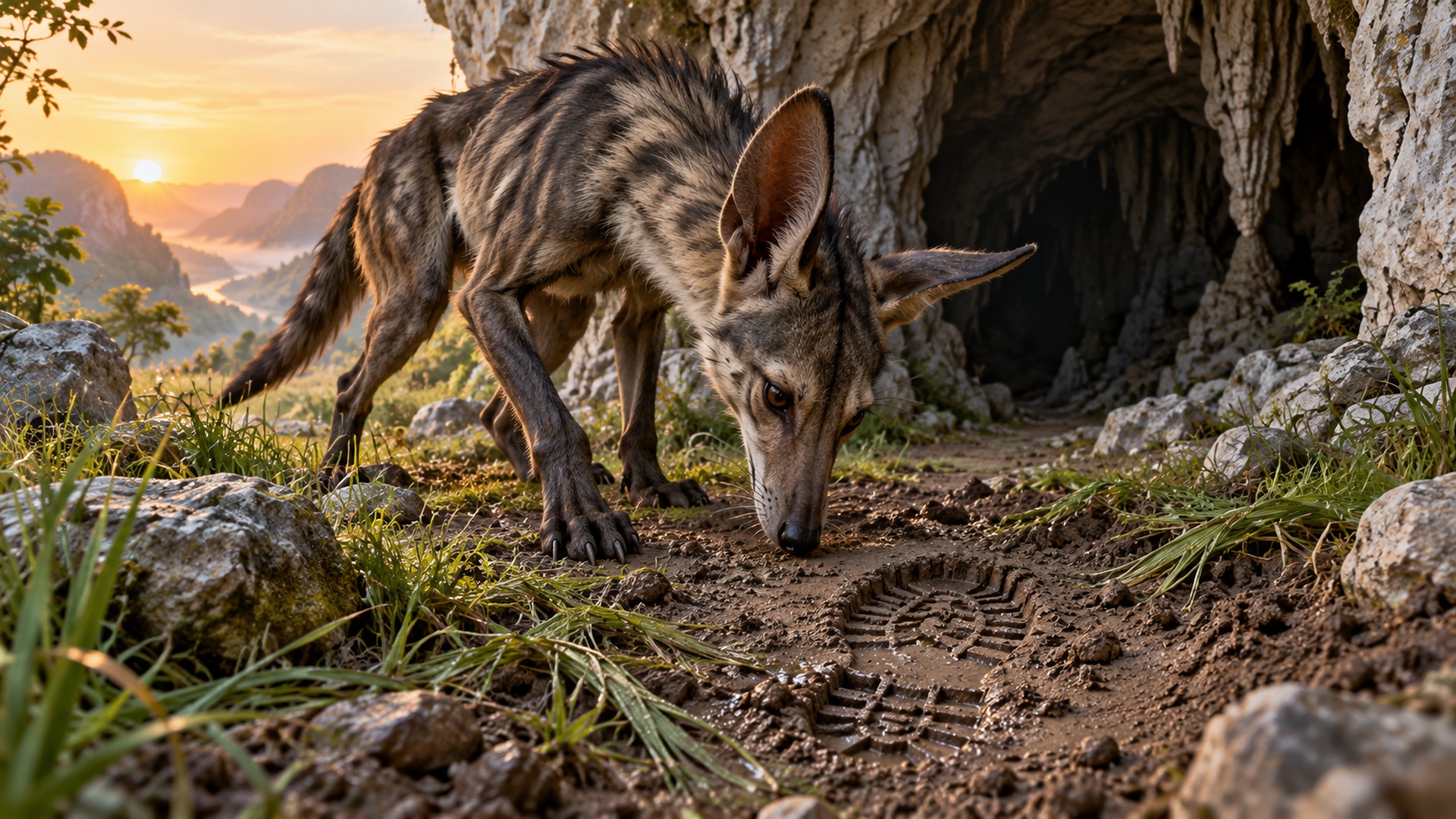
The person from the clearing walks toward a limestone opening, leaving several boot impressions in the damp approach. Inside, dry rock preserves no equally readable sequence. A boot sole may leave a recognizable tread in mud without recording every step across the stone beyond it. A light beam briefly crossing the entrance would be a different clue: its source must be present at that moment, although it might disappear immediately afterward. A creature arriving later can lower its head toward the last marks and sample the entrance air, but the change in surface interrupts one source of information. An odor near the opening suggests a past visit; a repeated interior sound can suggest something happening now. The animal has reasons to investigate without acquiring a complete map of the cave.
Now suppose the person has already left through a second opening. The boot impressions remain outside and some chemical traces persist, while the current sounds may come from dripping water or another animal. A tracker can search an empty chamber using the same senses that previously directed it successfully. That mistake follows from the age of the evidence, rather than a suddenly invented weakness. The sections that follow separate these cues: which ones can remain after departure, which need a present source, and which might help identify a human rather than merely another moving body. Each stage changes what the hunter can reasonably learn from the same journey.
Separate Presence, Position, and Identity
Three different claims are often combined into the phrase the monster knows you are there. The animal might detect a disturbance, infer that a person caused it, or locate a particular person accurately enough to act. Those are not equivalent achievements. An unfamiliar odor can establish presence without direction, while a visible silhouette can establish location without personal identity. Even a recognized individual can move after the last reliable sample. Keeping these stages distinct makes a creature’s actions easier to explain and gives suspense a meaningful progression from uncertain evidence to a more confident response.
Human Movement Produces Visual Contradictions
A person can become visible through contrast with the surroundings, changes in an outline, or movement that does not match nearby vegetation. Clothing and equipment can add shapes or reflective surfaces unfamiliar in the local habitat. Yet the usefulness of those cues depends on illumination, viewing position, and the observer’s visual abilities. A creature need not see a detailed human face to notice something worth investigating.
Recognition can improve through repeated observation. An animal familiar with people may associate a general posture, movement pattern, or accompanying activity with a particular kind of encounter. A fictional creature can do the same without possessing an encyclopedic understanding of human intentions. It might distinguish ordinary passing activity from someone approaching its shelter, for example. That interpretation belongs to the observed situation and the animal’s experience rather than to an automatic ability to read a stranger’s plans.
Voices and Equipment Create Different Acoustic Clues
Human voices can reveal activity beyond a direct line of sight. Footsteps, clothing movement, carried objects, and equipment can add other sounds. A creature’s hearing range and the acoustic environment determine which components are useful. A sound inaudible or unremarkable to a person may matter to another receiver, but that possibility requires a specified sensory ability rather than the assumption that every monster hears everything.
Distance and direction remain interpretation problems. Reflected sound in a cave or among buildings can arrive from a misleading direction. A brief noise may be difficult to classify, while a repeated event can support a stronger inference. The animal may turn its head, move to another position, or wait for the sound to recur. Those actions give hearing a process that differs from simply receiving a location marker.
Artificial sounds can also become learned signals. A creature repeatedly exposed to a particular activity might associate an engine or a recurring mechanical noise with people. That association does not mean it understands the device. It can recognize a useful pattern without knowing how the source works. A story gains credibility when the creature responds to the pattern it could actually have encountered.
Odor Can Preserve a Visit After the Visitor Leaves
People emit and carry chemical mixtures through skin, breath, clothing, food, and materials around them. A receiver able to detect some of those compounds could obtain information even after visual contact is lost. The exact interpretation would depend on its receptors and experience. An unusual mixture may indicate an unfamiliar animal or object without revealing a person’s name, emotional state, or precise route.
A trace is also affected by time and the medium carrying it. Airflow distributes airborne molecules unevenly, while material left on a surface can persist under different conditions. Rain, changing temperature, new activity, and the substrate itself can alter what remains available. A fictional tracker should therefore treat a scent trail as changing evidence. Pauses and lateral searches can show it trying to regain information that has become intermittent rather than following an imaginary unbroken line.
Footprints Record Contact, Not a Complete Biography
An impression in soil reveals that a contact occurred under particular conditions. Its shape reflects the foot or footwear, the load, the motion, and the surface receiving it. A creature with suitable perception and experience could use disturbances as part of a tracking routine. That does not establish that it can infer every human characteristic from one print, especially if the material has shifted or the impression is incomplete.
Several traces can add context. A sequence of impressions, displaced vegetation, and repeated contact with obstacles may suggest a direction of travel. The evidence can still be ambiguous where routes cross or surfaces change. A trail that disappears on rock has not necessarily ended there. For a monster, searching beyond that transition is a more grounded behavior than instantly knowing which unseen route the person selected.
Size and age estimates deserve particular restraint. A deeper print is not automatically a heavier individual because moisture, substrate strength, and movement all affect depth. A sharp-looking edge does not supply an exact timestamp under every weather condition. The story can preserve useful inference without pretending that tracks contain a standardized set of answers independent of how they formed.
Body Heat Supplies a Conditional Signal
A warm human body may create useful thermal contrast for an animal with an appropriate sensory system. Elena O. Gracheva and colleagues’ 2010 Nature paper, Molecular Basis of Infrared Detection by Snakes, provides a specific biological example of specialized thermal-sensing anatomy. Such an ability would still depend on the scene and intervening material. It would not justify a universal ability to identify people through arbitrary barriers. Other warm objects could create competing cues, and detecting a source would not by itself explain what the animal concludes about that source.
Water and Shared Surfaces Connect Bodies Mechanically
A person entering water creates disturbances different from those produced while standing on a dry bank. An aquatic receiver could obtain information from local motion if its anatomy supports that channel. The pattern would be influenced by currents, obstacles, and other activity. A splash can indicate an event without identifying its cause, and a continuing disturbance may be more useful than one isolated pulse.
Solid supports can also connect a person and a receiver. Walking along a shared branch or structure may create vibrations that reach another location. Transmission is specific to the material and geometry, so the same behavior on loose ground may provide a different signal. A fictional creature’s response should change with those connections. The environment becomes an information pathway rather than an empty distance between bodies.
Human Habits Can Make Evidence Predictable
Regular activity can teach an animal where and when encounters are likely. A route, a repeated stop, or a recurring sound can create predictable opportunities for observation. The creature need not possess unusual sensory range if it already occupies a favorable location. Apparent tracking ability can sometimes be explained by familiarity with a place and a pattern of behavior.
This is particularly useful in fiction because it gives the monster an independent routine. It might investigate the same crossing each evening or respond to a disturbance associated with people entering its habitat. Characters may interpret the repeated encounter as proof of an impossible sense when the creature is using local knowledge. Revealing that relationship can make the animal more coherent without removing its threat.
Prediction must remain fallible. A person can depart from a habitual route, activity can cease, and conditions can change. If the creature reacts to new evidence, its behavior can evolve without suddenly gaining omniscience. The difference between an expected meeting and an actual detection should remain visible, especially when the story depends on what the animal could plausibly know.
Several Weak Clues Can Support a Stronger Inference
A single rustle could have many causes. A rustle combined with a humanlike outline, a familiar odor, and a recently disturbed surface provides a more specific pattern. Multiple channels can therefore improve interpretation even when none is perfect. The creature may move from general investigation to a directed approach as those clues converge.
Conflicting information should matter too. An old odor may suggest a person passed through, while current visual evidence shows an empty area. A sound may arrive from a different direction than an apparent trail. The monster can resample or choose between imperfect explanations. Those decisions make perception an active part of the scene and prevent every sensory cue from functioning as an infallible command.
Detection Does Not Tell the Creature What to Do
Even a confident human identification leaves the animal’s motivation unresolved. It might avoid people, defend a location, investigate an unfamiliar event, or seek a learned association such as discarded food. None of those responses follows automatically from detecting a human signal. A useful explanation separates the sensory process from the behavioral decision that follows. The monster’s ecology and experience determine why the information matters, while its receptors determine what information is available. That separation allows two creatures with similar senses to behave very differently around the same person.