Stealth Is the Management of Unwanted Signals
A leaf shifts although the surrounding plants remain still. A pebble rolls once and stops. Something large may be moving nearby, but the observer has only fragments from which to recognize it. That is the essential problem of stalking: every approach changes the environment and risks producing information that prey can use. A monster cannot become stealthy merely by having dark skin or moving slowly. It must manage visibility, noise, scent, vibration, and the target’s changing attention while still making progress. Each channel behaves differently, and improving one can make another worse. Dense cover may hide a body while brushing against it noisily; a quiet surface may leave the creature exposed. Exploring these tradeoffs gives a scientifically informed answer to how a monster might stalk prey. It also produces better suspense, because concealment becomes an ongoing negotiation with the habitat rather than an unexplained ability to vanish whenever the story needs it.
A: Yes. Detecting a disturbance and identifying its source are separate steps.
A: Its effectiveness depends on the background, illumination, viewpoint, and observer.
A: Substrate, contact, body loading, and exposure time can change the outcome.
A: A receiver able to detect them may gain information through shared surfaces.
A: Airflow and turbulence create uneven, changing distributions of scent.
A: It may need a view while keeping most of its body concealed.
A: Additional observers can cover sightlines the nearest target does not.
A: The available cover must accommodate a larger body and its disturbances.
A: No. Signals can be present while their meaning is misunderstood.
A: Movement, cover, sensory channels, and changing conditions remain connected.
Being Unrecognized Is Different From Being Undetected
A target can register movement without knowing what caused it. It may see an unfamiliar shape but fail to classify it as a predator, or recognize danger only after several ambiguous cues combine. Detection, identification, and an escape response are therefore distinct stages. A fictional stalker might exploit uncertainty without being literally invisible. The moment when an ordinary-looking patch resolves into a face can be frightening precisely because information was present before its meaning became clear. This distinction also prevents camouflage from being treated as a perfect on-or-off state.
Camouflage Must Work From the Prey’s Viewpoint
A pattern that looks convincing to a human viewer may not conceal an animal from its intended target. Species differ in visual sensitivity, spatial detail, and the cues they use to recognize shapes. Distance and viewing angle change the effectiveness of a pattern too. Creature design should therefore begin with the observer and the background, rather than assuming that mottled green skin automatically works everywhere vegetation grows.
Breaking up an outline can make a body harder to separate from surrounding textures. Matching broad colors may help under one illumination while leaving the animal conspicuous against a different surface. Exposed eyes, a smooth horn, or a regular row of limbs can remain recognizable despite a well-patterned torso. The useful design question is which features betray the animal from the likely viewing position.
Changing backgrounds create additional costs. A creature hidden against bark may become obvious when it steps across pale gravel. It can choose a route that preserves concealment, accept a brief exposure, or stop and wait for better conditions. Each response reveals a strategy. A stalk feels more deliberate when its path reflects the continuity of useful backgrounds instead of following the shortest possible line.
Motion Can Reveal a Well-Matched Body
Visual systems are often sensitive to changes in the scene. A body that blends into a background while stationary can become easier to notice when its edges move independently of surrounding objects. Joanna R. Hall and colleagues tested this distinction in their 2013 Proceedings of the Royal Society B paper, Camouflage, Detection and Identification of Moving Targets. Human observers searched computer displays rather than watching live predators. In their moving-target tests, camouflage did not preserve the stationary target’s detection advantage, but identifying a target among similarly patterned moving distractors could remain difficult. Noticing movement and deciding what moved were different tasks. A monster scene can use that distinction without treating the experiment as proof of a particular animal’s hunting ability.
For a monster, the important consequence is behavioral. It may move during other disturbances, minimize abrupt changes, or pause when the target’s attention turns toward it. Those choices need not involve humanlike reasoning; they can arise through evolved behavior and learning. A scene can show the strategy through timing. The creature advances while branches move, then settles when the visual field becomes quiet.
A Quiet Step Depends on Contact and Substrate
Footfalls generate sound through interactions between the animal and what it touches. Dry leaves, hollow wood, loose stones, wet mud, and solid rock produce different results. The same foot placement can be quiet on one surface and conspicuous on another. A large body has additional load to transfer, making the selection and testing of supporting surfaces especially relevant.
Soft tissues may cushion contact, but padding cannot silence every consequence. Vegetation can scrape the limbs, a claw can catch against stone, or a shifting load can break a hidden branch. Long appendages add surfaces that can touch the environment outside the animal’s immediate view. A stealth specialist needs a body envelope and movement pattern that account for those interactions, not just quiet soles.
A slower pace can give more time for controlled placement, yet it also lengthens exposure. On an unstable surface, waiting may allow sinking or further movement under the foot. A monster might therefore use different pacing over different patches, moving deliberately through one and crossing another quickly. Quietness is an outcome of the whole contact sequence rather than a permanent property of a gait.
Sound Travels Through More Than Open Air
A prey animal may receive disturbances through the ground, a branch, or the water as well as through its ears. Whether those cues are useful depends on the medium, background noise, distance, and the receiver’s sensory abilities. A predator crossing a shared support could reveal itself even when its airborne sound seems faint to a human observer. The implication for fiction is straightforward: choosing a quiet approach means considering the physical pathways connecting hunter and target. An environment can conceal one signal while transmitting another surprisingly well.
Scent Adds a Moving, Uneven Trail of Information
Odor molecules disperse through air in patterns shaped by turbulence, obstacles, temperature, and local flow. They do not form a simple glowing line that always points directly to an animal. A target may receive intermittent traces, lose them, and encounter them again after the wind changes. The uncertainty can work for or against a stalker, depending on which animal detects whom first.
A fictional predator that positions itself with respect to air movement gains a plausible sensory advantage without gaining guaranteed success. Vegetation, gullies, warm surfaces, and changing weather can complicate the flow. An approach that was favorable moments earlier may become less so. Giving the creature a reason to stop, turn, or abandon a route makes scent part of an unfolding physical scene.
Light Can Expose the Smallest Contradiction
Concealment depends partly on illumination. A hidden body can cast a moving shadow across an exposed surface, while a reflective eye or wet patch can create a brief highlight. Silhouettes become easier to recognize against a bright opening. These effects can reveal the presence of an animal without showing its full anatomy, providing a rich set of cues for suspense.
A monster might keep below a skyline, avoid crossing a strongly lit gap, or wait for changing cloud cover. Yet darker conditions also reduce the information it receives unless its own senses compensate. The strategy has a cost: concealment and observation are often linked. A creature that hides its head completely may lose the view needed to judge when movement is safe.
This tension helps differentiate designs. A low-eyed crawler may watch from near the ground while keeping most of its body covered. A tall stalker might need to lower its head and alter its posture near openings. An animal with sensory structures extending beyond its main body may gather information while exposing those structures to detection or damage. Each solution creates a different visible behavior.
The Target’s Attention Changes the Available Route
Prey do not observe their surroundings uniformly. Feeding, social interactions, movement, and other disturbances can change where attention is directed. A stalker may gain opportunities during those changes, but the target can also become alert for reasons unrelated to the predator. A sudden pause in the prey’s behavior should therefore force reassessment rather than guarantee that the stalk has been discovered.
Groups complicate the approach because different individuals may look in different directions. A route concealed from one observer can remain exposed to another. The hunter must respond to the actual field of observation, not merely the nearest animal’s head position. That makes an approach through several sightlines a different problem from stalking one isolated target.
Size Creates a Larger Concealment Problem
A huge creature has more body to hide, more load to place, and often a larger physical path through vegetation. Those disadvantages do not make stealth impossible in every setting, but they change what the animal needs. Deep water, extensive terrain features, or a background that already contains large shapes can conceal different parts of a massive body. Small bushes cannot plausibly hide a creature whose shoulders tower above them.
Scale also affects how a disturbance is interpreted. A target might initially perceive a distant movement as an environmental event rather than an animal. That delay can support a fictional approach, provided the story does not confuse misinterpretation with an absence of signals. The creature’s success comes from what the observer concludes, not from an unexplained cancellation of its physical presence.
A giant stealth specialist can therefore be designed around selective exposure. It may reveal only its upper head above water, use terrain to cover its lower body, or align its outline with a broken rock face. Its attack range and posture should match the concealment available. The result is more convincing when the habitat clearly supplies enough space for the body the reader is asked to believe is hidden.
A Believable Stalk Can End Without an Attack
Stealth has no value if maintaining it costs more than the opportunity offers. A route can become exposed, wind can change, or a target can move beyond a useful distance. A predator that withdraws under those conditions preserves resources and avoids an unnecessary struggle. For a monster story, that withdrawal can be unsettling because it shows an animal making decisions outside the immediate expectations of the characters.
The strongest stealth scenes connect every movement to a signal and every pause to a changing condition. Camouflage shapes recognition, contact shapes noise, air movement shapes odor, and the prey’s behavior changes what can be noticed. None of these mechanisms guarantees invisibility. Together they create a creature whose approach belongs to its environment. When the final clue reveals it, the audience can recognize that the evidence was there all along.
A Leaf, a Scrape, and a Recognizable Edge
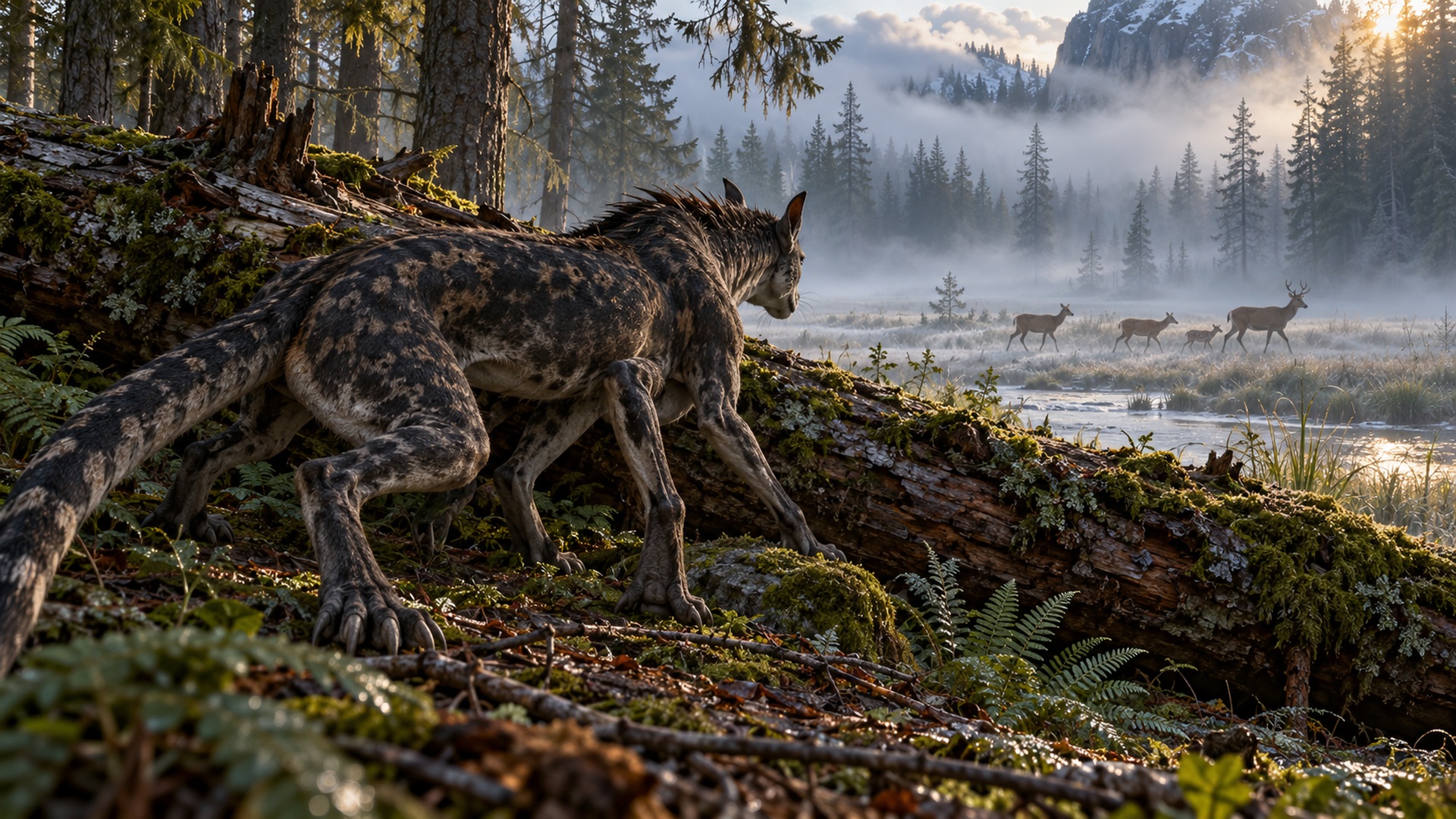
Picture a mottled creature waiting among windblown reeds. Its body colors initially resemble the vegetation, but a crossing step sends one edge across several otherwise stationary stems. A patch that looked like shaded bark now moves as part of a shoulder. The observer can follow that boundary even while other parts remain difficult to separate from the background. Matching colors have helped the waiting animal, but the new contact and changed outline create another visual problem. The observer notices the discontinuity before identifying the body; a scrape against dry stalks then helps locate it. If the wind shifts, scent can add another imperfect clue, while wet ground may make the next foot placement quieter than the first. Each event concerns a different signal, so suppressing one does not erase the others. The reveal comes when these clues make the hidden shape recognizable, giving the stalk a physical history instead of requiring an unexplained switch from invisible to visible.