The Hunt Begins Before Anything Gives Chase
A monster does not need to sprint at the first sign of prey to become frightening. It can follow a familiar route, pause where several trails meet, watch a clearing, and disappear before another animal notices it. Those quiet choices turn movement into hunting behavior. The later charge is only one possible stage in a sequence that also includes searching, selecting a target, approaching, deciding whether to attack, maintaining contact, and recovering afterward. Different creature bodies favor different sequences, while habitat determines which movements are practical. A heavy ambusher may wait for an animal to enter a narrow approach; a mobile hunter may cover ground until it finds an opportunity worth pursuing. Neither strategy works simply because the creature looks dangerous. Its senses, energy budget, limbs, and environment must cooperate. Following the whole sequence explains how monsters could hunt in a biologically grounded story and gives creators a richer vocabulary than alternating between a slow stalk and a sudden run.
A: No. Position, alertness, risk, and the hunter's condition can make waiting preferable.
A: It may need concealment, reassessment, or a better opportunity to move.
A: Its location and readiness are part of the hunting strategy.
A: Turns, braking, obstacles, and timing can outweigh its straight-line advantage.
A: The hunter moves toward a possible future meeting point.
A: The remaining opportunity may no longer justify its energetic or injury cost.
A: Handling and control introduce a different movement problem.
A: The creature can alter its route or timing in response to observed failures.
A: Their pauses, posture changes, cover choices, and transitions can express different strategies.
A: Yes. Hunting phases can change with circumstances rather than fitting one permanent label.
Search Movement Is About Finding Opportunities
Before a predator can approach prey, it must encounter useful information. Searching may involve traveling between feeding areas, inspecting cover, following trails, or revisiting places where animals regularly pass. The best route is not necessarily the shortest line across a map. A longer path that passes through productive habitat can provide more opportunities than a direct crossing of an empty area. Familiarity can make the animal look purposeful without implying that it knows every target’s location.
A fictional hunter’s search style should match what it can sense. A ground-focused tracker may slow near disturbed vegetation, while a visually oriented hunter may choose positions overlooking open spaces. The movement pattern is a way of collecting information. Repeated pauses can therefore be active work rather than indecision. If the monster changes direction after investigating a particular cue, readers can infer a decision without needing a humanlike explanation of its thoughts.
A Target Becomes Worth Approaching Under Specific Conditions
Detection does not obligate an animal to attack. A potential target may be too distant, too alert, poorly positioned, or costly to handle after capture. The predator’s condition matters as well: injury, recent feeding, competing threats, and the need to return to shelter can change its priorities. A monster that watches an opportunity pass can feel more convincingly alive than one that attacks every moving object. Its restraint tells the audience that hunting involves selection, and that the eventual approach reflects a judgment about circumstances rather than an automatic response to motion.
Stalking Breaks Travel Into Short Decisions
A stalk is an approach managed around the risk of detection. Instead of maintaining one constant pace, the predator may move while prey looks away, pause when it becomes attentive, and reposition when cover changes. The exact rhythm depends on the species and setting. For a fictional animal, the useful principle is that each movement alters both distance and the chance of being noticed. Closing the gap faster is not always progress if it makes the target flee too early.
Pauses can serve several purposes at once. They reduce visible motion, allow the hunter to reassess position, and give time to interpret changes in the target’s behavior. A creature that settles its weight before moving again seems to manage its body deliberately. That detail is especially useful for a large animal whose limbs might brush vegetation or disturb loose material. Stillness becomes part of its locomotion strategy rather than the absence of behavior.
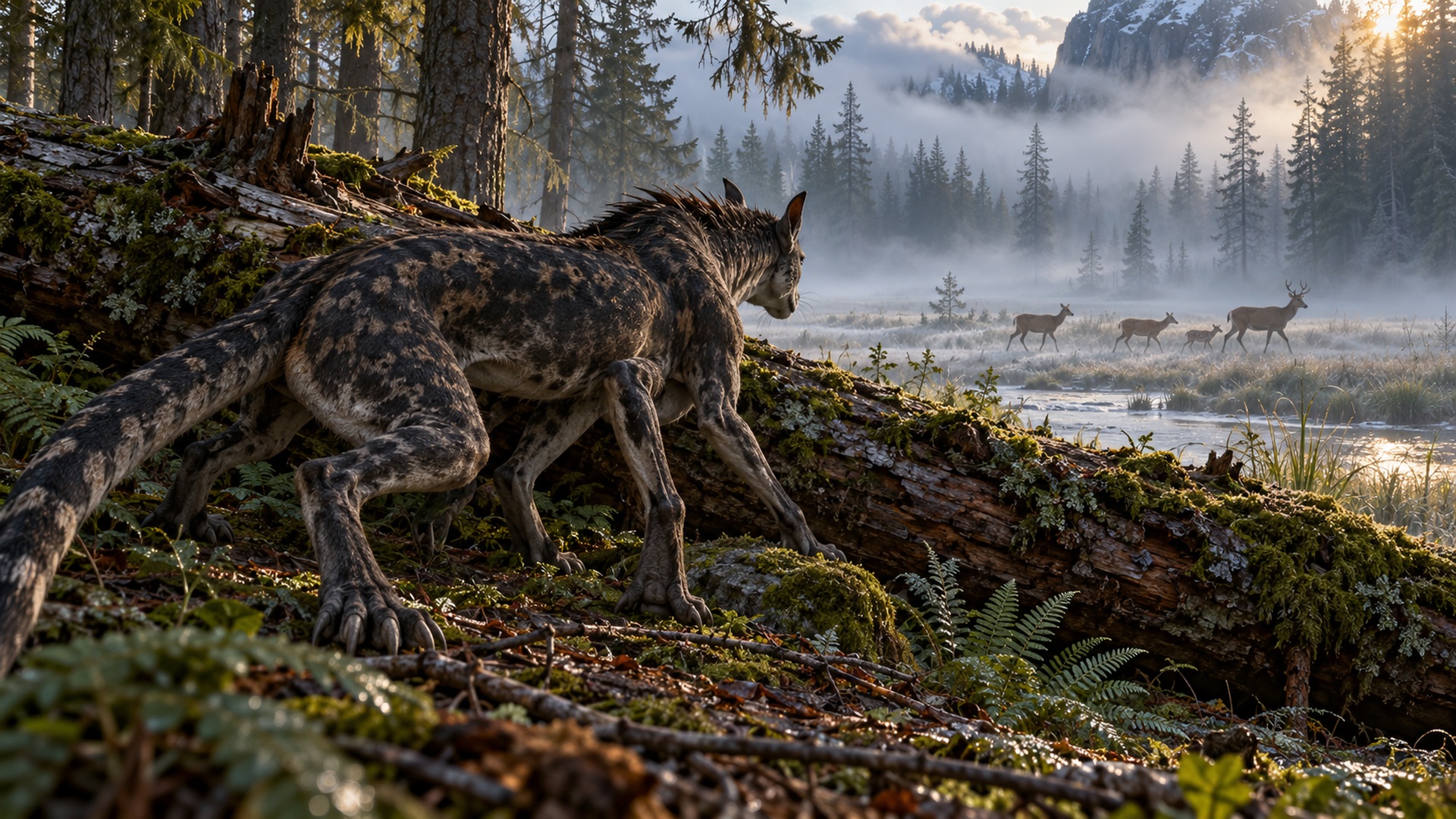
The final approach can also require giving up a tempting direct route. A fallen trunk may hide the torso but force the animal to move around an exposed end. Taller vegetation may conceal the head while revealing a moving back. These mismatches make stalking interesting because the environment offers incomplete solutions. A monster’s particular silhouette determines which pieces of cover actually help it.
Ambush Changes Movement Into Positioning
An ambusher invests effort in reaching and maintaining a favorable location. It may occupy a trail junction, conceal itself beside a water crossing, or rest where an obstacle constrains a target’s choices. Waiting is effective only when prey is likely to enter the useful zone. A beautifully hidden position far from animal traffic may accomplish little. The strategy therefore combines habitat knowledge with the ability to remain ready.
Once the opportunity arrives, the movement can be brief. A lunge, a short rush, or a sudden extension of the head may close a distance that would be expensive to cover in a long pursuit. The ambusher’s body should support that initial action and tolerate its consequences. A story can reveal its design through the transition from compressed readiness to a controlled burst. Afterward, the animal must either establish contact or decide whether continued pursuit is worthwhile.
Pursuit Depends on Turns as Well as Speed
A chase is not simply a contest between two maximum running speeds. The target changes direction, terrain interrupts foot placement, and both animals must manage acceleration and braking. A predator that reaches a higher straight-line speed can still lose an opportunity if it cannot follow a turn or recover its position. Alan M. Wilson and colleagues’ 2013 Nature paper, Locomotion Dynamics of Hunting in Wild Cheetahs, used GPS and motion-sensing collars to record 367 predominantly hunting runs by five cheetahs in Botswana. The measurements followed acceleration, braking, and turns as well as speed. A cheetah can close a gap quickly yet still need to redirect its momentum when prey changes course; the fastest instant does not describe that whole maneuver.
For a monster, body proportions should shape the chase. A long torso and heavy tail can change how a turn is initiated and controlled. A narrow trail may prevent the animal from using the same stride it uses in a clearing. A low branch might be a minor obstacle for the prey but require a substantial adjustment from the hunter. These details make the environment participate in the encounter instead of serving as a background that both bodies cross identically.
Braking deserves visible consequences too. An unsuccessful rush can carry the animal beyond the point where it can make useful contact. Recovering may require new foot placements, a turn, and another acceleration. That sequence costs time and effort. A predator that anticipates the target’s route can avoid some of those costs, explaining why positioning and experience can rival raw speed in an effective hunting style.
Interception Can Replace Following From Behind
A hunter does not always need to occupy the target’s previous path. Moving toward a likely future meeting point can shorten the distance it must cover. That requires usable information about the target’s movement and enough flexibility to respond when the prediction fails. An intercept is therefore an evolving estimate, not evidence that the creature can see the future. The target’s own reactions continue changing the situation.
Terrain can make interception more plausible by limiting available routes. A gap between rocks, a narrow bank, or an opening through dense vegetation can concentrate movement. A creature familiar with the area might move toward one of those locations rather than follow directly. The scene then reveals intelligence through spatial choices. It also offers a clear limit: an unfamiliar or unusually flexible target may escape the pattern the hunter expected.
Contact Introduces a New Movement Problem
Reaching prey is not the same as controlling it. At contact, the predator must manage a moving load while keeping its own support and avoiding injury. A strike that looks spectacular but leaves the animal badly off balance may be less useful than a quieter contact that preserves control. Jaws, forelimbs, body mass, and terrain can contribute differently depending on the creature. Hunting choreography becomes more convincing when the transition from approach to handling has its own mechanics rather than being treated as an automatic finish.
Failed Hunts Shape the Next Decision
A missed opportunity has consequences even when no injury occurs. The animal has spent energy, revealed its presence, and possibly alerted other nearby prey. It may continue searching, move to another area, or rest before trying again. A story does not need a fixed success rate to acknowledge those costs. Showing the creature abandon a poor continuation can communicate experience and self-preservation.
The failed attempt may also provide information. A target could escape through an unexpected opening, react earlier than usual, or lead the predator onto an unfavorable surface. A capable hunter may change its next approach in response. That learning should remain connected to what the animal could observe. It is more believable than granting perfect knowledge after every failure, and it allows repeated encounters to develop without changing the monster’s anatomy.
Recovery movement can be distinctive in its own right. An exhausted pursuit hunter may return along a sheltered route, while an ambusher may reoccupy a favorable position after the area becomes quiet. Grooming, drinking, and resting can belong to the aftermath. These behaviors make hunting part of a larger life rather than the creature’s only state of existence.
A Coherent Hunting Style Has Transitions
To build a recognizable monster, decide how it passes between search, approach, attack, and recovery. A patient tracker may become suddenly forceful when distance closes. A nervous ambusher may abandon an approach as soon as its concealment fails. A territorial specialist may rely on a small set of familiar interception routes. Each pattern creates a different kind of suspense because the audience learns what changes in the animal’s behavior mean.
These transitions should have physical tells. A lowered head, redistributed weight, shortened stride, or change in the direction of attention can announce a new phase before the decisive movement occurs. Reusing the animal’s own signals consistently gives viewers something to interpret. The tension comes from understanding that a decision is approaching, while remaining uncertain about which opportunity the creature will select.
Let Ecology Give the Monster Its Pace
Follow an imagined hunter along a river crossing rather than beginning when it charges. It searches the bank, pauses where prey trails meet the water, and approaches only after a useful target appears. If the target turns onto rough ground, the hunter must decide whether another acceleration is worth the effort. This sequence has distinct phases even though the observer might remember only the final rush. The cheetah study’s instrumented runs offer a real reminder that movement changes within an encounter.
Food distribution helps explain those choices. Predictable crossings reward waiting, while scattered opportunities can favor more search travel. Water levels, vegetation, and prey availability can shift the useful route. An animal that withdraws after losing position has not necessarily become less capable; it may have abandoned a poor opportunity. Recovery and the next search belong to the same explanation as the attack.
The resulting monster has a daily routine instead of an endless pursuit mode. Its posture announces a change from searching to approaching, its surroundings determine where acceleration is useful, and a failed attempt affects what it does next. That makes the encounter readable without assigning every hunter one rigid label. The threat begins when the creature finds a worthwhile opportunity, and it continues as a sequence of physical decisions long before contact occurs.