The Empty Street Is an Outcome, Not an Explanation
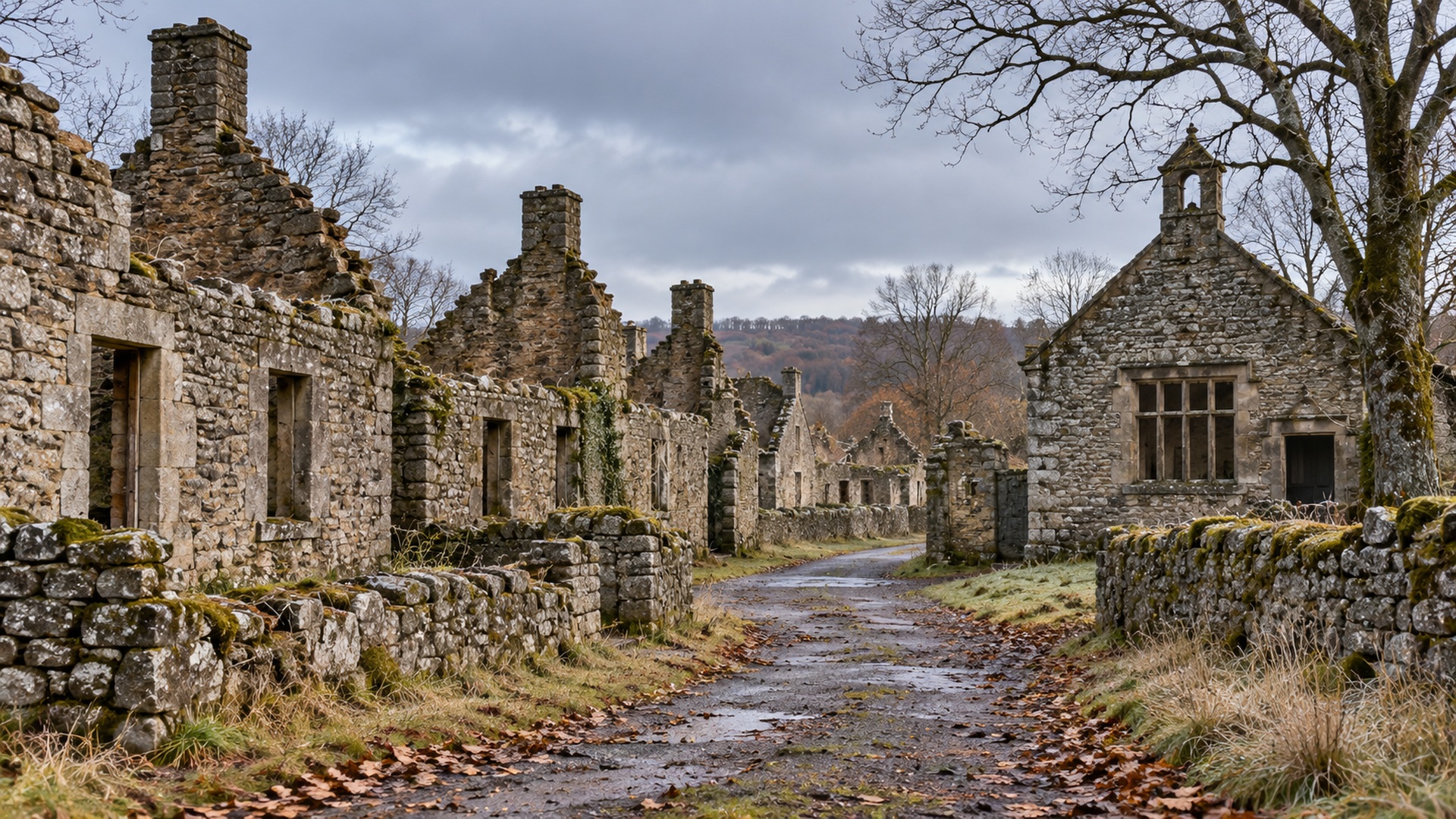
A village street still leads past houses, a school, and places where neighbors once met. The layout remains understandable, but the activity it supported has stopped. Some abandoned places feel unsettling because that interruption has a documented and difficult history. War, disaster, persistent environmental hazards, and state decisions can leave very different traces behind. Their stories do not need a fictional curse to become affecting. They do need precision, because a preserved memorial village is not the same kind of place as a gradually relocated town. The examples below examine those differences through Oradour-sur-Glane, Pripyat, Centralia, and Tyneham. The purpose is to understand why their former uses ended and what the remains communicate, while keeping the communities larger than the dramatic images commonly used to represent them.
A: Its ruins commemorate a documented massacre and a particular destroyed community.
A: Its destroyed buildings were retained to commemorate and document the massacre, with ongoing interpretation and remembrance.
A: Its fire and relocation involved continuing conditions and decisions.
A: No. The accident occurred on 26 April 1986 and the city evacuation followed on 27 April.
A: Relationships and memories can continue among people living elsewhere.
A: The mine fire and later relocation, acquisition, and demolition unfolded over many years.
A: It actively shapes what survives and how later audiences encounter it.
A: The War Office required the land for expanded military training in December 1943.
A: The major event may be known; its impact does not depend on an unverified presence.
A: The particular people, processes, and records that explain why its former use ended.
Oradour-sur-Glane: A Village Destroyed on 10 June 1944
On 10 June 1944, members of the Waffen-SS division Das Reich massacred the inhabitants of Oradour-sur-Glane in occupied France and burned the village. French memorial institutions now commemorate 643 victims. The settlement included ordinary local families as well as people who had sought refuge in the region during the war. Its destruction was an atrocity committed against civilians, not an unexplained event that needs a supernatural explanation.
The attackers gathered residents and separated the men from women and children. The church became one of the principal killing sites, while groups of men were attacked elsewhere in the village. Marguerite Rouffanche survived the church and left testimony now represented in the Centre de la mémoire’s documentary collections. Naming a survivor makes clear that the village’s later meaning did not emerge from architecture alone. People witnessed, remembered, and struggled to communicate what had happened.
The ruined village was retained as a memorial, with a new settlement built nearby. Its visible destruction therefore has a continuing public purpose. A street, workshop, or church wall marks a community’s ordinary organization and the violence that interrupted it. The memorial’s work includes documentation and education as well as preservation of physical remains. Calling the site abandoned without that context would conceal the deliberate decision to keep evidence visible. The difficult history is powerful precisely because it concerns identifiable people and actions, rather than a vague atmosphere attributed to old stone.
Pripyat: Evacuation After the 1986 Reactor Accident
The accident at reactor four of the Chernobyl nuclear power plant occurred on 26 April 1986. Pripyat, built for the plant’s workforce and families, was evacuated the following day. International Commission on Radiological Protection Publication 146 places that evacuation on 27 April, roughly 37–40 hours after the accident. The sequence distinguishes the moment of reactor destruction from the later movement of residents. Schools, apartments, and public spaces belonged to a functioning community before those decisions changed the conditions of residence.
The city’s later appearance can make departure seem to have preserved every room exactly as its occupants left it. That is too simple: the intervening decades include weathering, movement of objects, maintenance decisions, and changing use of the wider zone. The reliable historical point is the forced interruption of ordinary life and the displacement that followed, not a fictional biography assigned to each photographed possession. Parents, children, plant workers, and other residents had lives beyond the empty city. Their evacuation created new journeys and communities rather than ending their history at the bus stop. Pripyat’s unease differs from Oradour’s memorial ruins because the causes and chronology differ. One concerns mass murder and deliberate destruction; the other concerns an industrial nuclear accident and an organized evacuation after it. Both can be affecting without being made equivalent.
Centralia: A Fire Below Ground and Decades of Relocation
Centralia’s mine-fire history began in 1962 beneath a Pennsylvania coal community. The U.S. Geological Survey describes the connection between abandoned workings, subsidence, and the later relocation problem. This was a persistent underground process, not a single surface blaze after which every resident immediately disappeared. Efforts to understand and control it became part of the town’s history over many years.
In December 1983, Congress appropriated $42 million for relocation of fire-affected residents and businesses, as recorded in Pennsylvania’s environmental agency material. Acquisition, departure, and demolition then changed the visible settlement. The result can be a street pattern without the familiar houses that once explained it. That absence is not the same kind of ruin as Oradour’s deliberately preserved buildings or Pripyat’s apartment blocks. Centralia makes the relationship between a concealed hazard and decisions at the surface unusually stark. The residents’ choices also occurred within a prolonged public and administrative response, rather than one uniform reaction on one day.
Disagreement and attachment to home belong in that account without being turned into evidence that the underlying problem was imaginary. Historical photographs of vents or smoke document particular moments; they do not provide a complete present-day map of conditions. The site’s disturbing quality comes from that gap between a recognizable town plan and an industrial legacy beneath it, with the relocation chronology explaining how the gap developed.
Tyneham: A Temporary Wartime Departure That Became Permanent
In December 1943, Britain’s War Office requisitioned Tyneham, surrounding farms, and neighboring land in Dorset to expand a gunnery range. Historic England’s record for the former village school places the building within that event and the community’s earlier history. Residents left homes, work, and familiar routes because of a military decision. Their departure was not a gradual vote of no confidence in village life, and the surviving buildings do not mean that the place had stopped mattering to them.
The expectation of return gives the story a particular emotional structure. The wartime departure did not become a restoration of ordinary village residence after the war, and Tyneham remained within the military training landscape. Its school and church can therefore be read as records of interrupted functions rather than anonymous picturesque ruins. The school’s significance lies partly in its former relationship with children, teachers, and families, not merely in the appearance of an empty classroom. The local record and evacuation notice connect the visible spaces to requirements imposed on real households. Compared with Centralia, the central process was requisition for training rather than response to an underground mine fire. Compared with Oradour, the village’s emptied buildings followed displacement rather than massacre. Those distinctions are essential to the history, while the shared feeling of an interrupted ordinary world explains why all four places can remain unsettling. The common image is an empty street; the reasons behind it belong to separate events and responsibilities.
Interruption Is Visible Through Familiar Functions
A schoolhouse is recognizable because its purpose is familiar. An empty row of homes implies repeated daily activity that the current scene no longer contains. The architecture can make absence understandable without showing any event directly. That is why modest structures can carry as much emotional weight as monumental ruins. They connect large historical processes with ordinary settings where people learned, worked, and lived together.
Departure Did Not End the Community’s History
People who leave a settlement carry relationships, memories, records, and disagreements elsewhere. The site may become unoccupied while the community continues in dispersed forms. A place-centered photograph rarely makes those continuities visible. A history that follows only the empty buildings can therefore stop too early.
Where possible, accounts should include what residents experienced after departure and how the place remained significant to them. That is different from inventing a universal emotional response. Some relationships with a former home may be painful, complicated, or change over time. The important point is that emptiness at the site does not imply an absence of continuing human history.
An Object Is Not Automatically a Complete Personal Story
Images of furniture, classrooms, or household items can invite a viewer to imagine a particular final moment. Yet the visible object may have a longer and less certain history. Its position in a later photograph does not by itself establish who last used it or why it remained. Those claims require supporting evidence.
This is a place where captions matter. An accurate description can identify a room and its later condition without scripting the actions of an absent family. The scene may remain affecting precisely because the viewer knows the limits of the record. Invented intimacy can make a photograph more dramatic while making its history less reliable.
Material evidence is still valuable. A documented object can connect an institution or household with a broader event. The task is to preserve the connection actually supported rather than filling gaps with a cinematic narrative. The people involved deserve a history based on what can be known about them.
Ruins Can Be Deliberately Maintained as Evidence
A preserved site is shaped by decisions about conservation and interpretation. Keeping a damaged building visible may serve remembrance, documentation, or education. That is an active purpose. It differs from a structure deteriorating without attention, even when both appear empty in a photograph.
Recognizing this work changes the account of time. The site has not simply stood still since departure. It has acquired later caretakers, meanings, and responsibilities. Those layers are part of its history and help explain why the remains are encountered in their present form.
Quiet Does Not Establish Present Conditions
A historical photograph or an account of former evacuation does not establish a site’s current access, condition, or use. Those can change. An explainer about history should avoid turning atmosphere into practical assurances about the present. The absence of visible people in a frame says little about ownership, maintenance, or what lies outside it. Keeping historical explanation separate from assumptions about current conditions prevents a compelling image from carrying claims it cannot support.
The Word Abandoned Can Hide Responsibility
Abandoned sometimes suggests that a place was simply left behind without reason or care. That implication fits poorly where residents were displaced by an atrocity, evacuation, hazard, or wartime decision. Naming the process restores agency and responsibility where the record supports them. It also keeps difficult events from becoming an indistinct force called the past.
Precise language can change a reader’s understanding in one sentence. A settlement evacuated under an order and a settlement emptied after an industry declined describe different relationships between people and place. Neither needs an invented disappearance. Both deserve an account of the conditions and decisions involved.
This precision is compatible with an accessible article. It does not require a full institutional history in every paragraph. A clear cause, a reliable source, and careful separation between evidence and interpretation can establish the essential frame. The remaining description can then develop the place without losing what makes its history specific.
Remember the People Beyond the Frame
The buildings can anchor remembrance, but they cannot contain the full lives of those associated with them. A former resident’s later work, family, or account of displacement belongs to the same history. Following those continuities prevents the place from being treated as a sealed container of suffering. It also changes the meaning of return, whether through memory, documentation, or public commemoration. The site is important because people lived there and because their experiences continue to matter beyond its boundaries. An affecting article can begin with an empty lane, but its explanation should reach toward those human connections rather than leaving the reader with architecture alone.