The Landscape Has Entered the Living Room
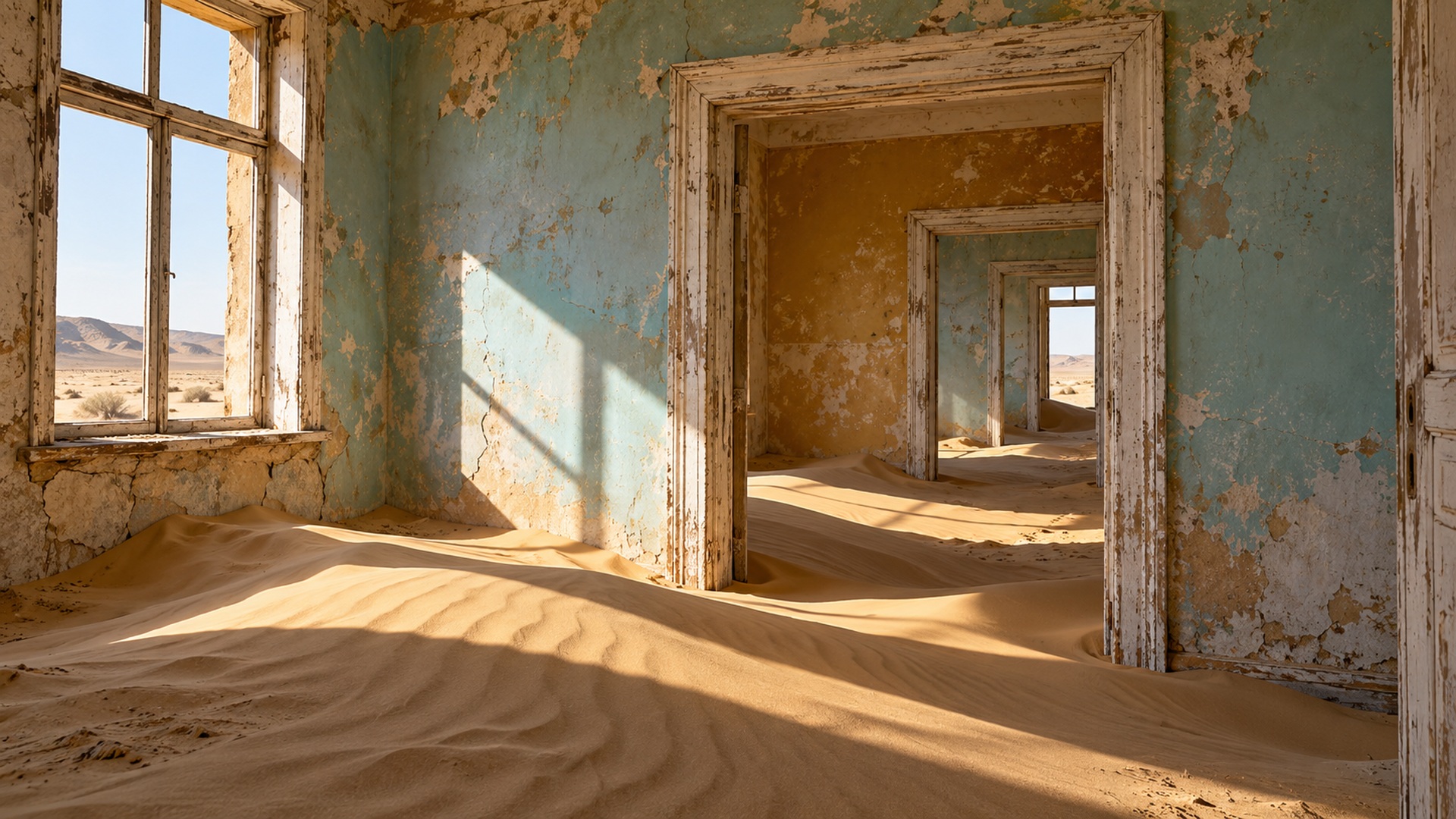
A dune rises against an interior doorway, making a familiar room look like part of the desert outside. The unsettling detail is not simply decay. It is the overlap of two arrangements that normally remain separate: a home organized for daily use and a landscape moving through it without regard for that purpose. Abandoned places often create this kind of contradiction. Streets remain where a community no longer follows its old routines, and buildings designed for crowds stand conspicuously empty. The examples below trace several different histories rather than ranking sites by an objective measure of creepiness. Mining, environmental instability, and changing economic conditions leave different kinds of remains. Understanding those causes makes each place more distinctive and keeps its former residents visible behind the dramatic images that circulate online.
A: Closure, relocation, and economic change can unfold through different timelines.
A: No. Local mining cessation and final residential abandonment occurred at different stages.
A: Its industrial and human histories require more than a dramatic exterior view.
A: A complete account includes people brought against their will and made to work under harsh conditions, as well as later industrial and family life.
A: Its company-town setting also preserves evidence of community and social life.
A: No. The 1963 landslide initiated a process reflected in clearance orders extending across later decades.
A: That claim requires evidence about the building and objects across time.
A: It restores the workers' shared social world, solidarity, and identity beyond the empty industrial structures.
A: Memory, family history, and community attachments can continue after relocation.
A: Identify its original purpose and the documented process that ended its former use.
Kolmanskop: A Diamond Settlement Left Behind by Its Industry
Kolmanskop grew near Lüderitz in what was then German South West Africa after railway worker Zacharias Lewala found a diamond in 1908 and showed it to his supervisor August Stauch. Debmarine Namibia identifies that discovery as the beginning of the rush and records the cessation of diamond mining at Kolmanskop in 1930. The settlement was therefore created for an extractive economy, not as a town that mysteriously lost its purpose without warning. Its buildings belonged to a short, intense period in which valuable deposits made an exceptionally demanding desert location worth servicing.
The later movement of mining toward deposits farther south helps explain why the old settlement lost that support. Closure of local mining and final residential departure were separate stages. National Geographic’s account dates complete abandonment to 1956, decades after the initial discovery. That interval matters: a photograph of a sand-filled room can suggest a sudden evacuation, while the economic history points to a longer process of decline and relocation. There is no need to invent a single dramatic morning when every door was left open.
The famous interiors are unsettling because domestic architecture remains readable while the desert crosses its boundaries. A doorway still implies passage between rooms, but accumulated sand can turn the same opening into part of a dune. The contrast records changing maintenance and use as well as weather. The settlement’s colonial setting also belongs in the account; a story concerned only with the prosperity of European buildings would leave out the unequal world in which the diamond economy operated. Lewala’s name is especially important because the discovery did not begin with an anonymous fortune seeker. The site now has an interpreted visitor identity, so its former residential abandonment should not be confused with complete absence of present-day care or activity.
Hashima: A Coal-Mining Community Above Workings Beneath the Sea
Hashima, often called Gunkanjima or Battleship Island, developed as a coal-mining settlement off Nagasaki. Mitsubishi took over the operation in 1890, and housing and services concentrated workers and families within a tightly bounded island form. Nagasaki’s historical interpretation describes a community with a school, hospital, shops, and recreation, rather than only industrial machinery. The mine closed in 1974, and residents departed within months. The cause of the empty buildings is therefore a recorded industrial closure, not an unexplained disappearance.
The community’s ordinary life is only part of its history. Wartime labor included Koreans and others brought against their will and made to work in harsh conditions; UNESCO’s consideration of the wider industrial heritage property has repeatedly addressed how that history is represented. Its 2021 UNESCO/ICOMOS mission report specifically criticized an interpretation conveying that no one had been forced to work at Hashima. This is why a vague invitation to consider the full history is insufficient. The island can represent both industrial development and coercion, and neither should disappear behind its dramatic silhouette. The physical density adds another layer: homes, schoolrooms, sea defenses, and production occupied one small, connected environment. After the work ended, those interdependent spaces could not retain their former community simply because the walls were still standing. Seen from outside, the island appears like one enormous abandoned structure; understood historically, it was a network of workplaces and households whose circumstances differed across time.
Craco: Landslides and a Relocation That Took Time
Craco’s old settlement rises on a hill in Basilicata, Italy, with a medieval core and buildings following the steep terrain. The same elevated form that produces its striking silhouette also makes ground stability central to its later history. Basilicata’s tourism authority identifies the 1963 landslide as the event that forced relocation from the old village toward Craco Peschiera. The local Pro Loco records a sequence of clearance orders beginning in December 1963 and extending to January 1991. Those dates distinguish the beginning of the crisis from the completion of a long administrative process.
Craco did not simply cease to exist as a community when the old houses became unsuitable for ordinary residence. People moved, and the settlement’s name and social life continued beyond the most photographed hilltop. That is why an image showing intact-looking façades can be misleading without context: visible walls do not establish that the underlying ground or the whole structure remained suitable for habitation.
The unsettling view comes from a recognizable town form continuing after its daily routes have shifted elsewhere. A lane still climbs toward buildings designed for people, but those buildings no longer perform the same residential job. This history gives the site a different character from a mine whose resource economy closed. Its central problem was the relationship between a long-inhabited place and changing or newly exposed instability beneath it. The surviving architecture is a record of that relationship, rather than evidence that former residents stopped caring about their homes.
Humberstone and Santa Laura: Work and Community in the Nitrate Desert
Humberstone began as La Palma in 1872, established for nitrate production in the Atacama region. The Corporación Museo del Salitre records its acquisition and renaming in 1934 and its definitive closure in 1960. Nearby Santa Laura belongs to the same wider saltpeter history, but the two works preserve different industrial and residential elements. UNESCO treats them together as an important surviving expression of the nitrate industry and pampino culture. Their empty spaces came from an economic system that once connected remote desert production with markets far beyond Chile.
The company-town arrangement joined employment to ordinary life. Housing, commerce, gathering places, and industrial maintenance formed an interdependent settlement, rather than a factory with incidental empty rooms around it. UNESCO emphasizes workers from Chile, Peru, and Bolivia and their shared culture and struggles for social justice. That history prevents the surviving buildings from becoming anonymous props for a ghost-town image. A work site could close while the memories and identities formed there continued among former residents and families. The present museum organization also represents another phase in the place’s use, conserving and interpreting what remains. Compared with Kolmanskop, the familiar desert setting should not conceal the difference between diamonds and nitrate, colonial Namibia and the pampino world, or their separate departure histories. The most evocative detail may be a theater or a domestic space, but its significance grows when it is connected back to the work and community that supported it. These were places where people built a daily world under demanding conditions, not settlements designed to become atmospheric ruins.
A Repair Workshop Reveals How the Desert Settlement Kept Running
The saltpeter museum’s account of Humberstone’s mold-making workshop explains a less spectacular but revealing part of industrial life. Obtaining replacement parts from outside could take time because of the site’s isolation. Wooden models supported the manufacture or repair of machinery components, making local maintenance part of the operation rather than a minor activity after production. A workshop therefore helps connect the big industrial structures with the people and skills needed to keep them useful. The desert town depended on more than the resource beneath it: it required repair, supply, and coordinated work. Understanding that function changes an empty workroom from generic decay into evidence of how a remote settlement sustained its daily economy.
Abandonment Has More Than One Cause
These places should not be grouped under a single story of sudden catastrophe. An industry can close, residents can relocate because conditions become unsuitable, or a settlement’s economic role can weaken over time. Different processes produce different traces. A room emptied gradually does not necessarily preserve the same kind of evidence as one left during an urgent evacuation.
The word abandoned can obscure those distinctions. It may suggest that nobody cared about a place when the actual history involves constrained choices, relocation, or continuing efforts to preserve it. Understanding the process changes how the remains are interpreted. A missing roof or empty street is an outcome that needs a history, not an explanation in itself.
That also changes the question the reader asks. Instead of imagining what mysterious force emptied every site, ask what supported the settlement and why that support changed. The answer may involve resources, ground conditions, policy, or work. It gives the place a specific past rather than assigning the same fictional disappearance to every quiet building.
Recognizable Uses Make Absence Easier to Feel
A doorway, stair, or row of homes provides a scale the viewer understands. The missing daily activity becomes noticeable because the architecture still suggests it. An empty machine hall works differently from an empty kitchen, but each preserves expectations about use. The unsettling effect depends on that recognition. A ruin reduced to an unidentifiable pile might be less immediately evocative than a nearly intact room whose ordinary purpose remains obvious.
Former Residents Did Not Exist Only to Leave Ruins
A community’s history includes ordinary work, family life, recreation, and disagreement. Its departure can be significant without becoming the only event worth remembering. People may retain attachments to a place long after their homes cease to be occupied. Those connections complicate the idea that an empty site has no living social world.
For a horror-oriented reader, acknowledging that history can deepen the atmosphere. The buildings imply actual lives rather than anonymous figures inserted to make the image sadder. Specificity creates a more affecting sense of absence. It also avoids turning displacement into a decorative explanation for why a photograph looks dramatic.
Preservation Is Another Chapter of the Place
A conserved ruin is not unchanged since its original use. Decisions about stabilization, access, interpretation, and what to retain shape how later audiences encounter it. Those decisions may preserve important evidence while altering the visible condition. Recognizing conservation as an active process keeps the site within history. It is still being interpreted and cared for rather than simply existing beyond time.
The Creepiest Detail Is Often a Changed Relationship
A room becomes part of a dune; housing remains after the mine closes; a hilltop town survives above the places where its residents rebuilt their lives. These changes connect material form with absence. They are compelling without an invented apparition. The place feels different because the relationship between structure, activity, and landscape has changed.
That is what the strongest abandoned-place stories explain. They do not simply announce that nobody lives there anymore. They show how the former arrangement worked and what its surviving traces now mean. The result is a landscape that can feel unsettling while remaining grounded in the people and processes that made it.