The Prey a Monster Ignores Can Explain Its Ecology
A large predator watches an animal pass and makes no attempt to follow. In a simple monster story, that pause might seem like a missed chance for action. In an ecological explanation, it can be the most revealing moment in the scene. The opportunity may offer too little food, demand too much effort, or expose the hunter to a damaging struggle. Predation is part of an animal’s attempt to obtain usable resources while remaining alive long enough to reproduce, not a permanent obligation to attack. A monster’s feeding strategy therefore includes the targets it selects, the places it searches, the risks it accepts, and what it does with food after obtaining it. Pursuit and ambush are only parts of that larger system. Understanding the economics of an encounter makes even an extraordinary creature feel like an inhabitant of a working ecosystem, with reasons for its choices that extend beyond the presence of the story’s main characters.
A: The attempt may offer poor return, excessive risk, or difficult handling.
A: Usable nutrition must be considered alongside capture, handling, defense, and processing costs.
A: Its value depends on waiting opportunities, habitat, success, and other ecological conditions.
A: Group benefits can arise through several mechanisms, including opportunistic encounters and sharing.
A: A species can combine resource strategies rather than fitting an absolute category.
A: Caching can create repeated access, with costs and limits of its own.
A: Avoiding a damaging confrontation can preserve its future ability to feed.
A: They alter resource distribution, access, competition, and the return from different opportunities.
A: A population also needs long-term resources, reproduction, and persistence through variable conditions.
A: Its gains, costs, handling anatomy, habitat, and current condition fit together.
A Meal Has Costs Before It Provides Energy
A potential food source offers more than its apparent size. Some of its material may be difficult to access or digest, while finding and handling it requires time and effort. An animal must also absorb the usable nutrients after feeding. The energetic value of the resource therefore cannot be inferred simply by looking at a large body or imagining one dramatic bite.
Costs accumulate across the whole attempt. Searching, approaching, pursuing, controlling, transporting, and defending food can all matter, though not every predator performs each stage in the same way. Failed attempts add costs without the same return. A fictional creature that repeatedly expends enormous effort for negligible nutrition would need another resource or an explicitly different motivation.
Risk is not identical to immediate energy expenditure. A manageable-looking encounter can still cause an injury that compromises future feeding. The animal’s existing condition changes how consequential that possibility becomes. A monster’s refusal to pursue a difficult target can therefore represent an effective survival strategy rather than a failure to behave like a predator.
Prey Choice Depends on Opportunity and Vulnerability
Predators encounter individuals under specific conditions, not abstract species descriptions. Position, alertness, group arrangement, terrain, and the hunter’s own experience can change how manageable a target appears. A formidable prey species may sometimes present a favorable opportunity, while a smaller animal can be difficult to locate or catch. A simple size ranking cannot capture those differences.
For a fictional hunter, prey selection becomes a way to explain specialization. It may prefer a particular habitat boundary, life stage, or seasonal concentration because those conditions make its own anatomy useful. That preference should remain conditional rather than universal. If the environment changes, the same target may no longer offer a worthwhile opportunity, and the creature’s behavior should be able to reflect the change.
Ambush and Pursuit Allocate Effort Differently
An ambush strategy can invest in a favorable location and wait for an opportunity to arrive, whereas a mobile pursuit strategy may spend more time traveling and responding to scattered encounters. Neither is automatically cheap or superior. Waiting carries opportunity costs, productive locations may be contested, and a poorly timed burst can still be expensive. Pursuit can provide more encounters while requiring a body and energy supply suited to repeated movement. Hubel and colleagues’ 2016 paper, Energy Cost and Return for Hunting in African Wild Dogs and Cheetahs, compares the costs of seeking and obtaining food with the returns that different hunting and sharing patterns provide. It asks what a strategy yields, rather than treating a spectacular chase as its own measure of success.
Handling Ability Shapes Which Resources Are Useful
Obtaining contact with prey does not complete the feeding problem. The predator must control a moving animal, access usable tissue, and process food with the structures it possesses. Jaws, teeth, claws, forelimbs, and digestive anatomy all contribute differently. A creature’s spectacular weapon may suit defense or display more than efficient feeding, so its actual diet needs a separate explanation.
Handling can limit the usefulness of very large targets. A resource may be abundant but difficult to access, defend, or consume before conditions change. Smaller items can sometimes provide a steadier return despite yielding less food per event. For monster design, this means an enormous body need not imply that every meal involves the largest available animal.
A signature feeding action can establish the relationship between anatomy and diet. The creature might grasp and manipulate a resource, hold it against a support, or process it gradually in a protected location. Those behaviors reveal function without requiring graphic detail. They also distinguish a feeding specialist from a creature that merely possesses an impressive collection of teeth.
A Pack Can Benefit Without a Perfectly Coordinated Attack
Tatjana Y. Hubel and colleagues’ 2016 Nature Communications paper, Additive Opportunistic Capture Explains Group Hunting Benefits in African Wild Dogs, examined an alternative to the familiar image of every member executing one elaborate maneuver. Multiple hunters can create capture opportunities, then share the food obtained. The gain can arise from the accumulation of individual opportunities and access to shared kills. Group feeding therefore needs to be examined as well as the visible chase.
For a fictional pack, this suggests concrete differences among roles without giving every animal humanlike tactical knowledge. Several individuals may search or attempt short pursuits, while others gain through sharing and the group’s access to a resource. The actual benefit depends on encounter rates, capture success, and how food is distributed. A monster group becomes more distinctive when its advantage is specified: more opportunities, better access, or some defined coordination, rather than an automatic assumption that a pack performs every task perfectly.
Scavenging Is a Resource Strategy, Not an Insult
Food obtained from an existing carcass can reduce some capture costs while creating other challenges. The resource may be difficult to find, occupied by competitors, degraded, or costly to defend. Many animal diets need not fit an absolute division between hunting and scavenging. A creature can use both opportunities depending on what is available and what it can process.
Its sensory abilities may be particularly important in locating scattered resources. That role differs from pursuing live prey even if the same smell or sight systems contribute. A monster that investigates a distant feeding event may be following evidence of food rather than tracking a particular victim. The distinction can change the interpretation of an otherwise similar approach scene.
Scavenging also places the animal in a wider community. Other consumers, decomposers, and competitors affect the resource and the time available to use it. A fictional scavenger can be imposing without occupying the role of an invincible apex hunter. Its power may lie in locating opportunities and displacing smaller competitors under favorable conditions.
Design an Ordinary Resource Cycle for the Creature
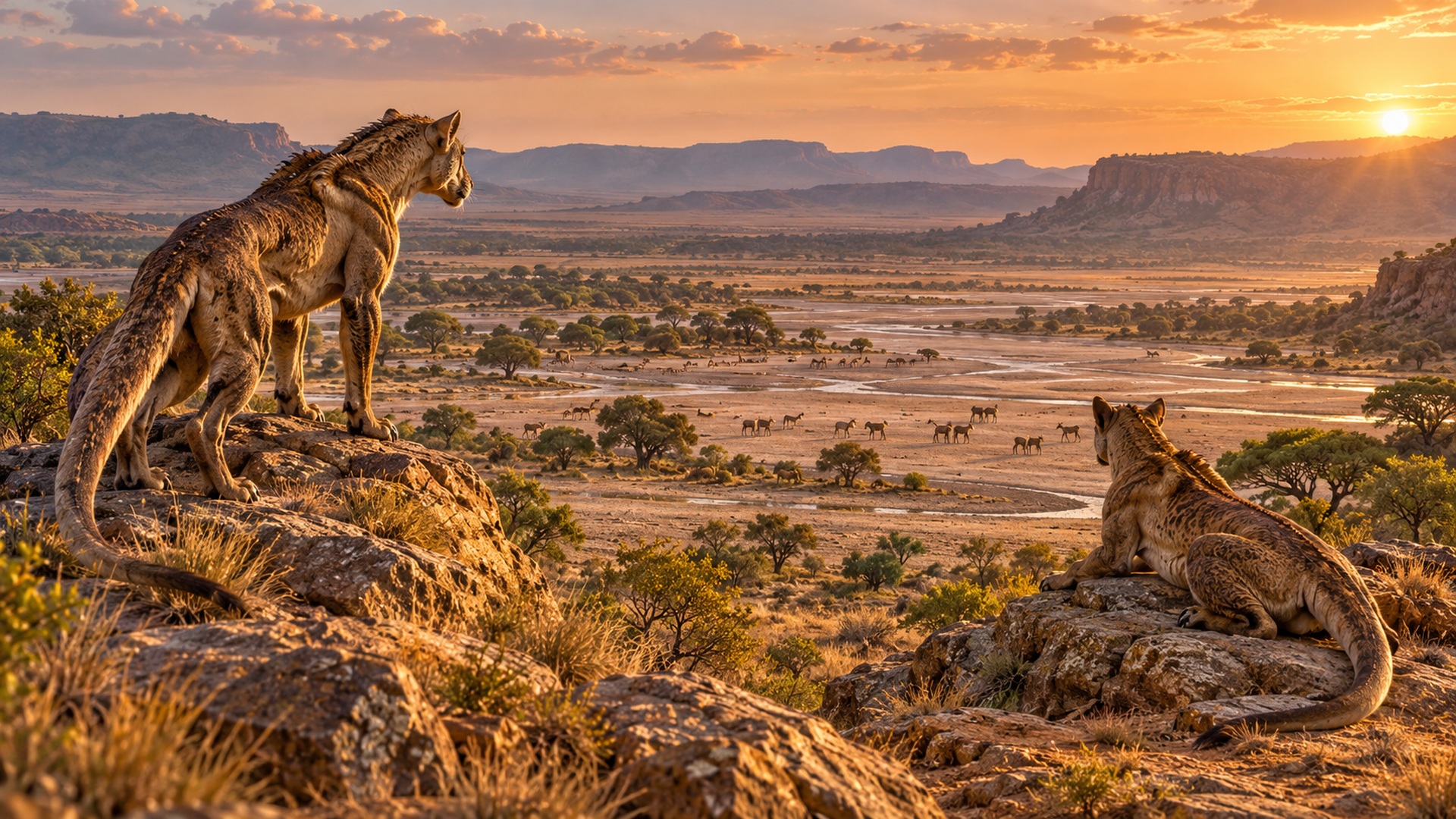
Consider a fictional predator using a dry floodplain. During a productive period, grazing animals concentrate near remaining water and create repeated encounters. The predator can learn useful approach areas, but it must also contend with other consumers attracted to the same resources. When rain redistributes water and grazing opportunities, those concentrations may disperse. A strategy effective near one crossing becomes less reliable, even though the predator has exactly the same teeth and muscles. Its movement into a wider area can follow directly from that change rather than from a sudden increase in aggression.
The same cycle can explain quiet scenes. An individual that recently obtained enough food may remain sheltered, investigate competitors, or visit a resource without attempting another capture. A younger or displaced animal can face a different return because it lacks access or local knowledge. Those differences give the population variation without assigning arbitrary personalities to every biological process. They also make the dramatic hunt part of a longer sequence of resource use. When readers understand the ordinary cycle, a departure from it becomes meaningful evidence that conditions have changed.
Stored Food Changes the Timing of Return
Some animals preserve access to resources by caching or otherwise using food across time. Such behavior can help connect a successful encounter with later needs, but it is not free preservation. The animal must transport or conceal the resource, remember or rediscover it, and cope with spoilage or theft. A monster’s stored food can explain repeated visits to a location and periods when it does not need to hunt. Its effectiveness should depend on the habitat and the species’ actual handling and cognitive abilities rather than functioning as an unlimited supply outside the food web.
Competitors Can Matter as Much as the Prey
A predator may obtain food and then lose access to it. Larger rivals, groups of smaller consumers, or disturbance can alter the return from an otherwise successful attempt. The animal must decide whether defending the resource is worthwhile. A retreat can preserve its ability to feed later, especially if the confrontation would introduce substantial injury risk.
Territory and timing can influence those interactions. A creature may use a location during a quiet period, shift its activity around competitors, or move food toward shelter. Such behavior gives a monster an ecological schedule independent of the characters. It also explains why the animal can be dominant in one setting and cautious in another without changing its physical abilities.
Seasonal Conditions Can Reshape the Whole Strategy
Food availability changes as animals move, reproduce, and respond to weather. Vegetation and water levels alter both resource distribution and the terrain through which hunters move. A location that concentrates prey during one season may become empty later. A creature tied to that location needs flexibility, mobility, or a way to survive the lean interval.
Changes in conditions can also affect handling and competition. A resource may persist differently in heat and cold, while access routes can become flooded or exposed. These factors modify the return from a hunt without requiring a change in the predator’s motivation. A story can use seasonal pressure to make an animal approach an unfamiliar area, provided the movement follows an understandable resource problem.
Life stage adds another dimension. Juveniles, breeding adults, and injured individuals may face different demands and capabilities. Their prey choices need not be identical. A convincing monster population can therefore include individuals that use overlapping but distinct feeding strategies, making the species feel broader than one adult antagonist repeating a single behavior.
A Feeding Population Leaves Effects Beyond One Encounter
A large predator participates in the ecosystem even when nobody watches it feed. Its resource use, movements, waste, and interactions can influence other animals and leave traces over time. A persistent population requires more support than one individual surviving a dramatic week. The habitat must sustain the relevant food sources and allow successful reproduction across variable conditions.
This perspective helps evaluate fictional scale. An enormous hidden carnivore cannot be explained only by describing one suitable victim; its longer-term resource base and population need consideration. A story may supply an unusually productive environment or a different metabolism, but those premises should do identifiable work. Ecology becomes the connection between the creature’s impressive body and a place capable of supporting it.
Give the Monster a Reason to Choose
A coherent feeding strategy explains what the creature gains, what the attempt costs, and why a particular opportunity matters now. Its anatomy shapes handling, its habitat shapes encounters, and competitors change the return. A predator can be dangerous while declining poor opportunities, using existing resources, or retreating from a costly struggle. Those choices make it more than an appetite attached to a silhouette. They create an animal whose behavior continues to make sense before and after the audience sees it hunt.