A Giant Can Be Stronger Without Moving Like a Superhero
Put a person beside a huge fictional creature and the obvious prediction is that the creature can exert more force. The less obvious question is what stronger means when the two bodies face different burdens. A giant may move an object that several people cannot shift, yet find climbing its own body up a ledge much more demanding than a human would. It may control an encounter through reach and mass without possessing remarkably powerful muscle tissue. Conversely, an animal with impressive strength relative to its weight may still produce less total force than a much larger opponent. Comparing monsters with humans therefore requires a defined task, a useful baseline, and an explanation of which assumptions are hypothetical. No single multiplier can describe lifting, running, gripping, striking, and endurance together. The interesting comparison follows how a larger body changes an ordinary action. That approach can explain a monster’s overwhelming advantage while preserving believable limits, making the creature more distinctive than a person whose abilities have simply been multiplied by a dramatic number.
A: Yes. Total force and force divided by body weight can produce different comparisons.
A: Its volume, and also its mass if density remains unchanged.
A: No. It is a hypothetical geometric model that omits many anatomical and task-specific factors.
A: Climbing moves body mass and depends on holds that can support the climber.
A: The cargo may represent a small additional burden relative to the much larger body.
A: The dimensions and fragility of the interface may suit human hands rather than its anatomy.
A: No. Length and force depend on different relationships and require separate assumptions.
A: It leaves sustained effort, recovery, and performance after fatigue unresolved.
A: Higher forces can overload supporting tissues if those structures do not change compatibly.
A: Name its baseline, task, assumptions, and unsupported quantities instead of presenting one universal multiplier.
Start With Two Different Meanings of Stronger
Absolute strength describes a force capacity without dividing it by the animal’s own mass. Relative strength expresses performance against some measure of body size, often body weight. These are different comparisons, and neither automatically replaces the other. A creature can produce a much greater total pull than a person while producing less pull per unit of its own body weight.
Give the thought experiment an imaginary 80-kilogram person capable of a 1,000-newton pull in a defined test. The geometrically doubled model discussed below would have a mass of 640 kilograms and, under its unchanged-tissue assumptions, four times the muscle force. Its illustrative 4,000-newton force is greater in absolute terms, but it is only half the original force-to-body-weight ratio. Moving an external object half a meter against a constant 1,000-newton resistance would involve 500 joules of work; the same distance against 4,000 newtons would involve 2,000 joules. Completing that movement faster would add a power requirement. Keeping the distance and resistance explicit prevents the word stronger from quietly changing meaning halfway through the comparison. Neither selected pulling value is a measured human benchmark or an external lifting prediction. The figures simply let us follow the same task through the arithmetic.
For a story, that distinction opens useful possibilities. A giant can dominate an external task yet treat its own body cautiously. A smaller character can be comparatively agile without being able to resist the giant’s pull. Both outcomes can follow from the same consistent design, so there is no contradiction to repair by giving one participant unexplained additional powers.
A Hypothetical Doubled Human Makes the Arithmetic Clear
Imagine a human-shaped model enlarged to twice every original linear dimension, with unchanged proportions, tissue properties, and density. Cross-sectional areas become four times larger and volume becomes eight times larger. If maximum muscle force follows the available physiological cross-sectional area under the stipulated conditions, a simplified model suggests approximately four times the muscle force alongside eight times the body mass. Force relative to body weight would therefore be about half the original value. This is an illustration of geometric assumptions, not a prediction about a real giant person. It excludes changes in posture, muscle architecture, leverage, and tissue properties, and it does not supply an exact external lifting capacity.
Why a Height Multiplier Is Not a Strength Multiplier
Descriptions such as ten times taller and ten times stronger sound compatible because they use the same number, but they express unrelated measurements. Height is a length, while force depends on anatomy, materials, and the conditions of an action. A taller body may have proportionally thicker limbs, a different torso, or a radically different distribution of muscle. Those differences can change the comparison even when the head reaches the same height.
The biomechanical scaling literature discusses how animals change posture and proportions as size changes. That is why geometric enlargement is useful as a baseline rather than a complete description of living diversity. A monster designer can depart from the baseline, but the departure should be specified. Otherwise the calculation appears to explain the creature while its most important assumptions remain hidden.
Compare the Same Action Under the Same Conditions
A human and a monster cannot be compared fairly if one pulls from a secure brace while the other lifts an awkward object at arm’s length. The direction of force, range of motion, contact points, and duration all matter. Even the same object can create different demands when one body can grasp it conveniently and another cannot. A published lifting number without those conditions says less than it appears to.
One useful fictional comparison is a horizontal pull on an object that both participants can grip securely. Describe the surface, the attachment, and whether the body can remain planted. Another is raising a balanced load through a specified height at a controlled pace. These comparisons establish a concrete task rather than implying that a single performance measures every kind of strength.
Results should remain tied to their test. If the creature pulls harder in the first arrangement, that does not prove it can jump higher, climb faster, or deliver a stronger bite. Those actions use different body parts and mechanical arrangements. Clear scope makes an impressive result more credible because readers understand exactly what has been demonstrated.
Reach and Body Mass Can Decide an Encounter Early
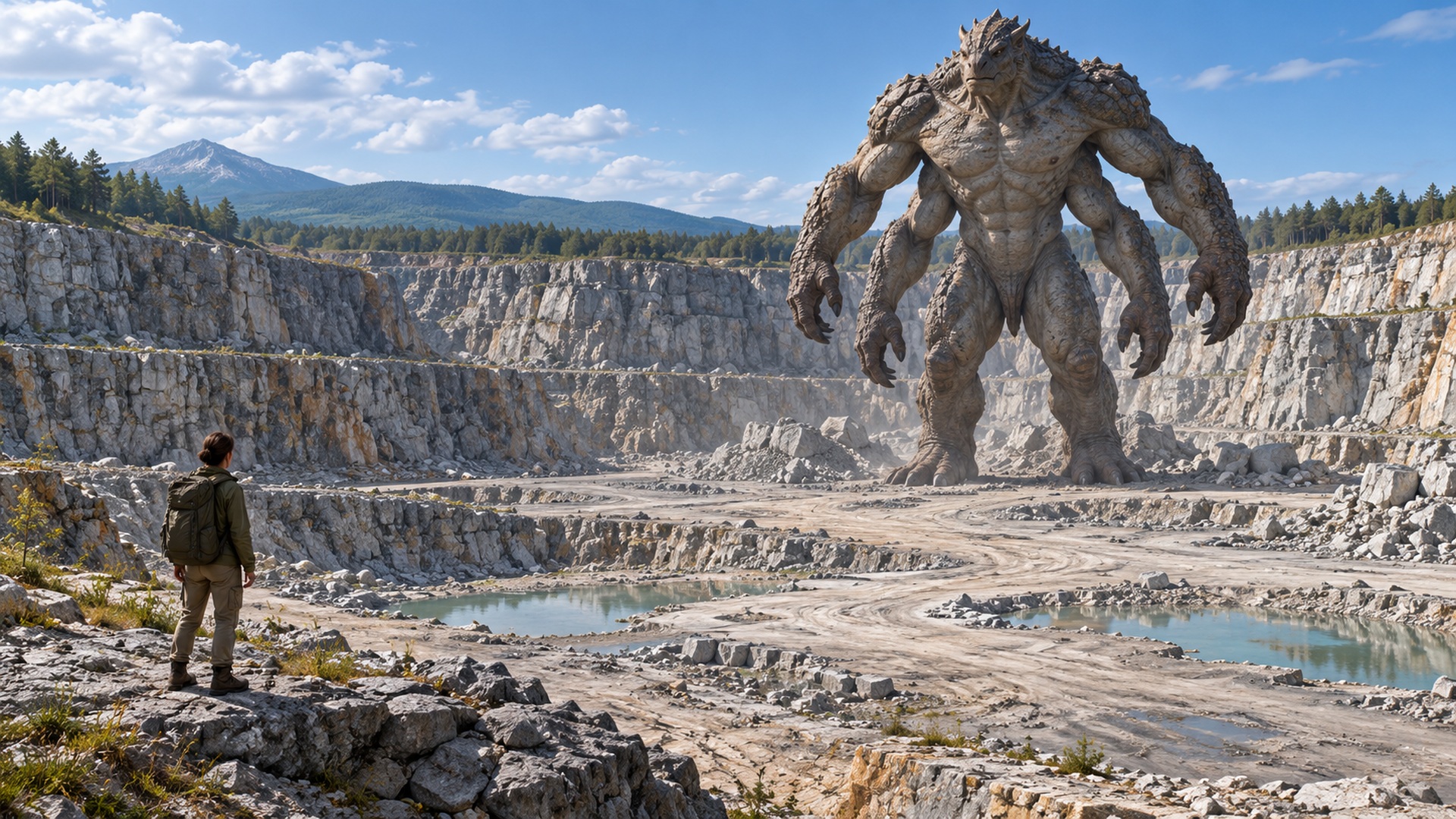
A much larger creature may control space a human cannot contest directly. It can contact an object or opponent from farther away, surround a smaller body with its limbs, or shift a heavy mass into a person’s path. Those advantages do not require a corresponding superiority in the force produced by each unit of muscle tissue. Body dimensions themselves change the options available to both participants.
Mass can also make a creature harder to displace under suitable conditions. Yet a heavy body still needs stable support and effective contact with the environment. A slippery surface, a tipping moment, or a fragile platform can change the outcome. The useful claim is that mass and reach can provide major situational advantages, not that they guarantee success independently of anatomy and terrain.
Human-Relative Strength Changes With the Task
Climbing is partly a problem of moving the climber’s own body against gravity. A very large monster therefore brings a correspondingly large load to every upward movement. Its holds must support that load, its hands or feet must stay attached, and the structures being climbed must survive. A person can be the more capable climber in one environment even while the monster can move much heavier loose objects on the ground.
Jumping is another self-acceleration task. The creature must generate an appropriate impulse through a movement range and then tolerate landing. A long limb can alter that range, while tissue performance and body proportions change the rest of the problem. Greater absolute force does not establish a particular jump height because the force is acting on a different mass over a different motion.
Carrying an external object introduces its own comparison. A load that is overwhelming for a person may be a small addition to a giant’s total mass. That can make the monster appear effortless without requiring unlimited relative strength. How the object is held still matters, especially when its shape places it far from the creature’s supporting joints.
Manipulating human-sized equipment may reverse the convenience. Handles can be too small, surfaces too fragile, and useful gaps too narrow for the monster’s digits. A person may complete the task more successfully because their body matches the interface. That is a difference in fit and control, not evidence that the smaller body suddenly generates the greater force.
Muscle Quality Does Not Replace the Rest of the Body
It is tempting to explain every extraordinary feat by declaring the monster’s muscles unusually dense or powerful. Muscle force depends on functioning contractile structures, their arrangement, and their operating conditions, so density alone is not a complete specification. Lomas S. Persad and colleagues’ 2024 review, Specific Tension of Human Muscle In Vivo, explains the more carefully defined quantity of force per physiological cross-sectional area. Even an exceptional value would still need a whole-body explanation before it became a dependable lifting number.
Tendons, bones, joints, circulation, and thermal control must remain compatible with the output. Increasing the force generated by a muscle can overload an attachment or make a joint harder to stabilize. A creature whose tissues all change together is a coherent speculative premise. One extraordinary tissue inserted into an otherwise ordinary body creates consequences that the story should recognize.
Brief Superiority and Sustained Superiority Are Different
A monster may generate a tremendous opening effort and then need to recover. A human comparison measured during that burst could produce a different ranking from one measured over a long work period. Energy delivery, heat accumulation, tissue fatigue, and the ability to maintain coordination influence the longer task. Endurance therefore deserves a separate description rather than being quietly included in a maximum-force claim.
The surrounding day matters too. A creature that has already traveled, hunted, or defended territory may not arrive at an encounter with the same available reserve as a rested animal. Food availability and temperature can further change what it can sustain. These conditions give a strong monster variability without making its biology inconsistent or requiring arbitrary changes in its abilities.
Stories can show that variability through behavior. An animal might avoid another burst, shift toward a slower method, or seek an environment where it can use body weight more efficiently. The audience sees an active creature managing its resources. That can make its eventual effort more impressive than repeated feats delivered without preparation, consequences, or recovery.
Keep the Model Separate From a Character’s Feats
Return to the imagined pulling test. Its 1,000-newton baseline and 4,000-newton doubled result come from stated assumptions, so changing the assumed muscle architecture or leverage would change the result. A film character’s published ability belongs to a different kind of claim. It tells us what that fictional incarnation can do, rather than independently demonstrating what enlarged human tissue would produce. Keep the two accounts identifiable even when they appear in the same comparison.
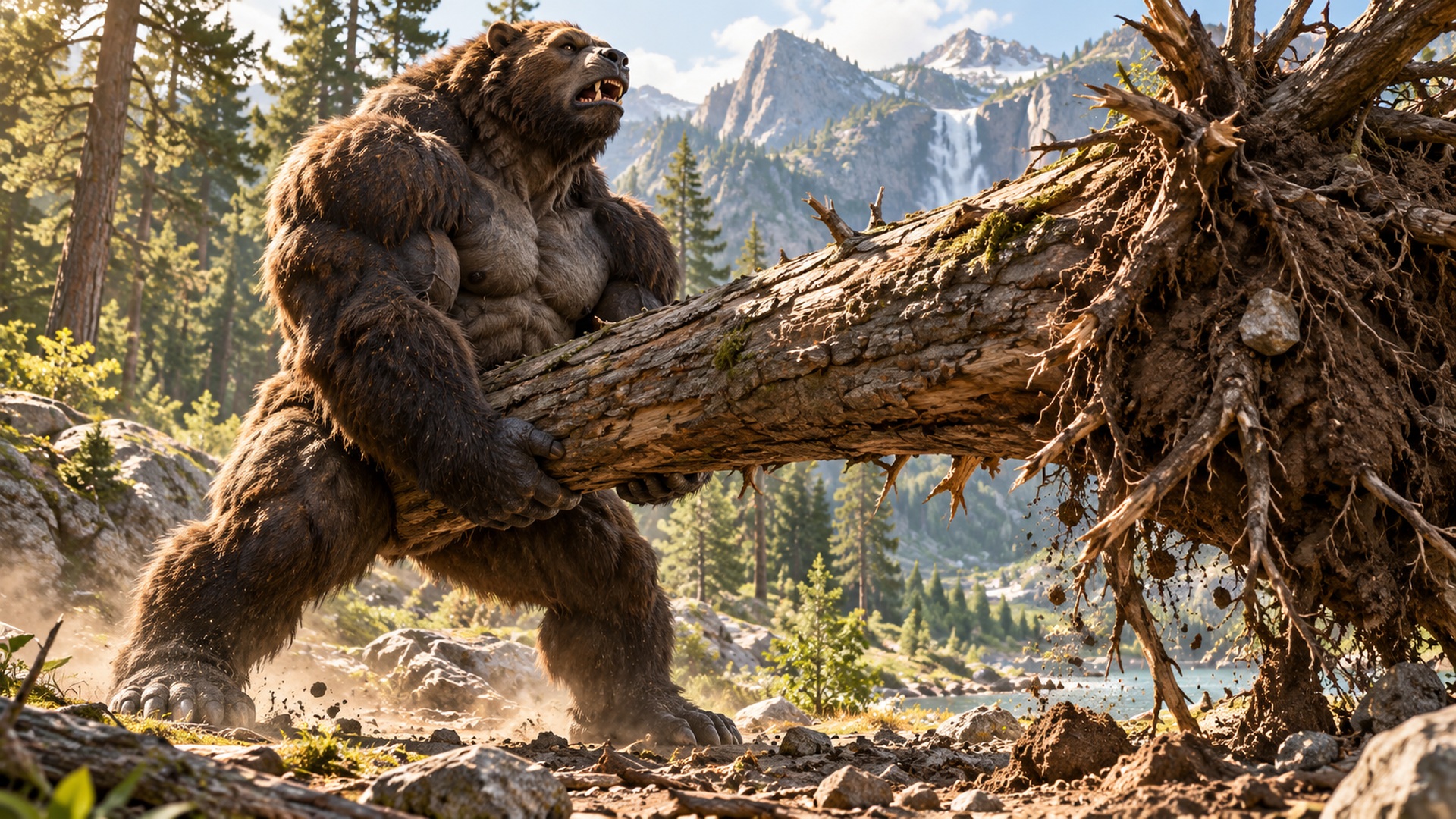
If the character pulls a vehicle, the next useful observation is how the vehicle moves. Rolling, sliding, and lifting require different forces, and the animal’s posture and contacts determine how much muscle force reaches the object. The scene may also imply an invented mechanism. Describe that allowance directly instead of adjusting an unseen strength multiplier until the calculation reproduces the spectacle. The result preserves both pleasures: the story’s extraordinary feat and a biological model whose assumptions can actually be examined.
Build a Comparison That Admits Its Limits
A transparent human-versus-monster explanation begins by naming the baseline person and the task, then distinguishes assumed properties from known relationships. State the scale factor, identify whether proportions stay fixed, and say whether the comparison concerns an external load or the creature’s own body. Keep force, power, work, and body-weight ratios separate. Describe contact with the environment and leave unsupported quantities unavailable. A giant can remain overwhelmingly capable within those boundaries. The result is more useful than an all-purpose strength score because it explains where the advantage comes from, when it changes, and which spectacular actions still require an explicitly fictional rule.