When the Landscape Turns Out to Be Alive
Han Solo thinks he has found a cave large enough to hide a spaceship. The ground feels wrong, the air is damp, and the apparent shelter eventually closes its teeth. The space slug in The Empire Strikes Back captures the pleasure of colossal monsters: something we understood as a place becomes a body. Other giants achieve their scale differently. Godzilla Earth rises above a forest, Dune’s sandworms make machinery look vulnerable, and the Midgard Serpent stretches around the human world of Norse myth. This selection follows nine memorable beings from screen creatures to world-threatening figures, explaining their actual stories and the scenes that make them feel enormous. Where a source gives a dimension, it is identified; where size is conveyed through a deed or an image, that remains part of the account. The result is a tour of extraordinary giants rather than a claim to rank every creature ever invented.
A: Godzilla Earth is described at about 300 meters tall, while the Star Wars Databank lists the space slug at 900 meters long.
A: Its listed dimension follows a long body; standing height measures a different direction.
A: They shape travel, industrial activity, and the Fremen's relationship with Arrakis.
A: The account discussed here conveys his magnitude through his fall upon Thangorodrim rather than such a measurement.
A: No. The encircling image belongs to the account's cosmology and does not supply that modern anatomical calculation.
A: The binding centers on restraint and Tyr's sacrifice; the Ragnarok account enlarges his release to cosmic proportions.
A: The 1986 animated film directly shows the planet-eating presence and transformation discussed in the article.
A: No. The scale of his appetite and the dimensions of an individual portrayal are separate matters.
A: The original encounter emphasizes overwhelming presence and limited witness knowledge rather than a stable engineering specification.
A: Each creature makes a familiar place or object seem radically smaller and changes what its surrounding world can contain.
Godzilla Earth: A Forest Dwarfed by Its Inhabitant
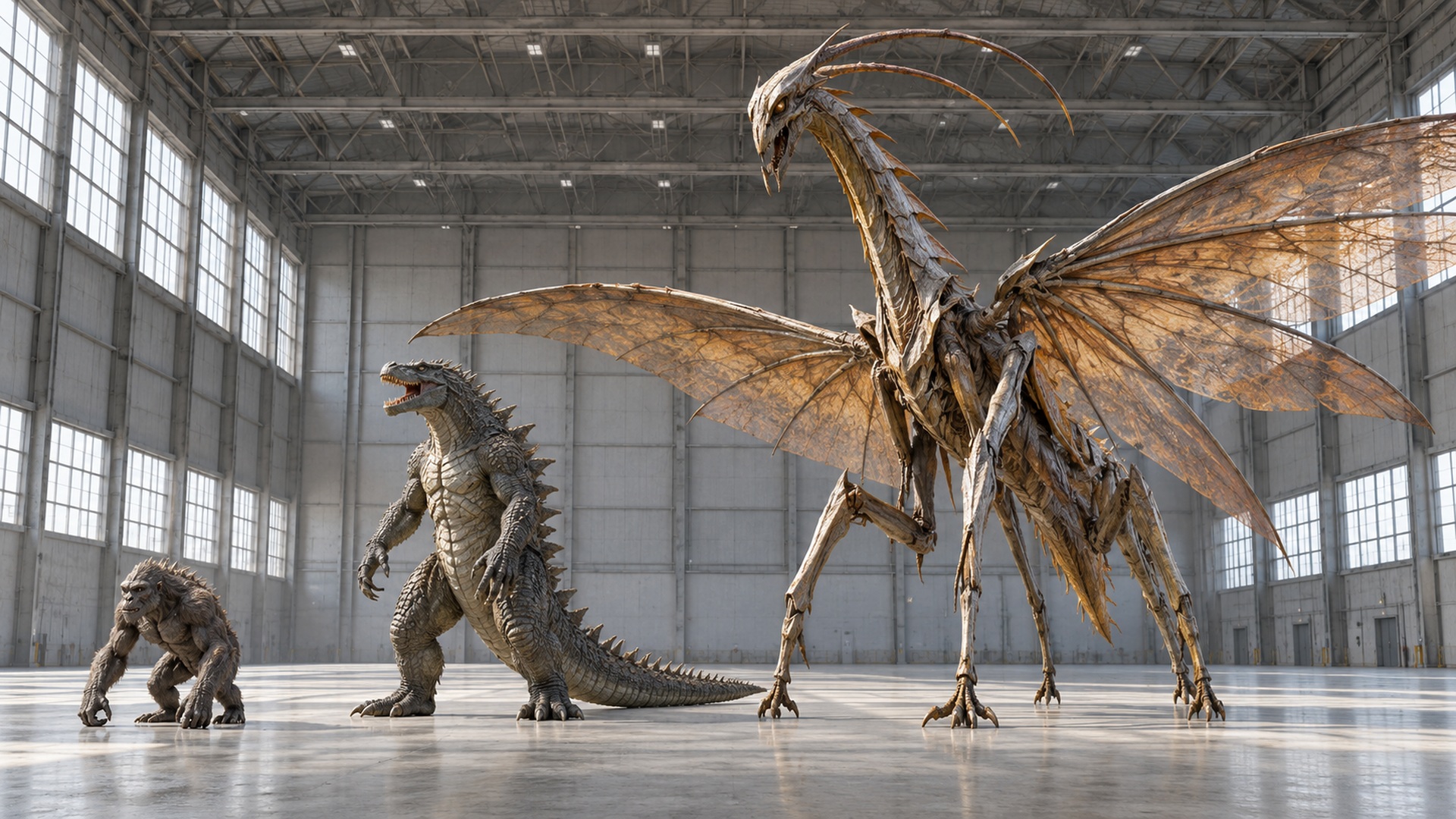
The Godzilla anime trilogy introduces a future Earth from which humanity has been absent for thousands of years. When people return, they confront an environment already transformed around its dominant creature. The official trilogy creature profile describes Godzilla Earth as approximately 300 meters tall. At that scale, a person standing nearby would have difficulty understanding the whole animal without moving a considerable distance away.
What makes this incarnation distinctive is the difference between fighting a giant and discovering that an entire landscape belongs to it. The smaller Godzilla-like creature encountered earlier has prepared an apparently manageable scale, then the much larger body changes the meaning of the expedition. Godzilla Earth’s enormous trunk, long tail, and ridged back make the familiar silhouette feel geological. The creature is not simply a larger opponent waiting at the end of a battle; it is the physical center of a world that has developed without accommodating human return.
The Space Slug: A Refuge With Teeth
In The Empire Strikes Back, the Millennium Falcon enters what appears to be an asteroid cavern while escaping Imperial pursuit. Mynocks, moisture, and the strangely soft surface become clues that this is not ordinary rock. The official Star Wars Databank lists the space slug at 900 meters in length, making it a long-bodied giant rather than a 900-meter-tall animal. Its reveal works because the travelers have already occupied part of its interior. When Han recognizes the danger, the familiar spacecraft becomes a scale reference racing toward an opening that can close. We do not need a complete exterior survey to appreciate the threat. The monster has already been large enough to function as a setting, and the escape turns that apparently safe setting into a digestive system.
Dune’s Sandworms: Giants That Control the Crossing
Frank Herbert’s Dune, published in 1965, makes its great sandworms central to life on Arrakis. They move beneath the desert and threaten people and equipment crossing exposed sand. Their presence changes practical behavior: travelers cannot treat an open plain as empty ground. The danger begins below the visible surface.
A harvesting machine provides a particularly effective reference for their scale. An industrial vehicle that seems substantial beside workers becomes a temporary object in the path of an approaching worm. The immense circular mouth does not need a human expression. Its opening makes the machinery, the waiting aircraft, and the evacuation suddenly feel small.
The Fremen’s relationship with the worms also prevents them from becoming interchangeable giant predators. Knowledge of movement, rhythm, and riding turns the same creature into a means of crossing the environment. The contrast becomes especially clear when a rider reaches the worm’s exposed surface. What appeared to be an approaching wall becomes terrain on which a person must find a workable position. The body can carry travelers because it is so much larger than they are, yet that same difference makes the approach dangerous. Herbert gives the creature a practical place in the Fremen’s skills rather than leaving it as an impressive sight on the horizon. Its size supports both danger and mobility. A sandworm is therefore not merely a battle statistic: it helps determine who understands the desert and who can survive within it.
Ancalagon: A Dragon Remembered Through His Fall
J. R. R. Tolkien’s The Silmarillion places Ancalagon the Black in the War of Wrath, when Morgoth sends out winged dragons against his enemies. Eärendil fights from the sky, and Ancalagon’s defeat ends with the dragon falling upon Thangorodrim and breaking its towers. The episode connects a body with a catastrophic change in the stronghold below. It is one of fantasy’s most forceful descriptions of dragon scale.
The text does not supply a height or wingspan that can responsibly be converted into a precise chart. That absence leaves the actual event more compelling than an invented mileage figure. A creature falls, a seemingly permanent feature of the enemy’s realm is broken, and the landscape records the defeat. Ancalagon’s place in this selection rests on that narrative magnitude. His name evokes the moment when the death of one monster becomes a disaster large enough to alter the setting of a war.
Jormungandr: The Serpent Around the Human World
In Snorri Sturluson’s Prose Edda, Jormungandr is one of Loki’s children and is cast into the sea surrounding the human world. The serpent grows until it encircles that world and grasps its own tail. This is scale expressed through cosmology: its body occupies a boundary of existence, rather than simply threatening a harbor. Thor’s fishing encounter makes the immense being briefly confrontational, while the account of Ragnarok places their final battle within a wider catastrophe. The serpent’s poison and Thor’s fate matter as much as its length. Calling it a world-encircling creature preserves the story’s extraordinary image without pretending that Snorri supplied the circumference of modern Earth as an anatomical measurement. Its body is memorable because the sea itself seems to hold a continuous, living threat.
Fenrir: A Wolf Whose Release Changes the Sky
Fenrir begins in the Prose Edda as a wolf the gods attempt to bind. The apparently delicate fetter Gleipnir succeeds where more obviously formidable restraints fail, and Tyr loses his hand in the process. The episode makes the giant’s strength personal before the later catastrophe expands it. Gleipnir’s makers are dwarfs, and its components include impossibilities such as the sound of a cat’s footfall and a woman’s beard. The restraint looks less formidable than the chains Fenrir has already overcome. That reversal is central to the scene: visible bulk is not the only kind of power in the story. A hand and a binding offer points of contact with a creature whose future cannot be safely ignored.
At Ragnarok, the description becomes cosmic: the wolf advances with jaws reaching toward earth and heaven, and Odin is swallowed. The image of a gape that seems to exceed the room available for it communicates a world losing its boundaries. Fenrir is not merely an unusually large wolf in a forest. His release turns a familiar animal action—opening the mouth—into an event with the proportions of the end of the gods’ order.
Unicron: A Planet That Opens Its Mouth
The Transformers: The Movie, released in 1986, introduces Unicron through planetary destruction. His rounded machine body approaches a world, and its mouth makes a civilization into something that can be consumed. The scale reference is no longer a person or a vehicle. It is the place on which those people and vehicles depend.
Transformation then gives that planetary presence another body. A giant robot can direct hands and attention toward a world that had seemed like an adequate stage for every earlier conflict. This change makes the familiar idea of a powerful Transformer feel inadequate. The characters are confronting a being whose anatomy can include spaces large enough for their own journeys.
Hasbro’s character material also identifies Unicron as a planet-sized threat, although different Transformers continuities develop him differently. The 1986 film remains a clear starting point because it shows the visual argument directly. A world is eaten, a planet becomes a figure, and the surviving characters have to find a kind of response that ordinary military strength cannot supply.
Galactus: Enormous Appetite Beyond a Fixed Height
Galactus enters Marvel’s Fantastic Four story in issues 48–50, published in 1966, bringing a threat organized around the consumption of worlds. His armored humanoid appearance makes cosmic appetite strangely legible: a figure arrives with a purpose, and Earth is the resource at stake. Marvel’s own character introduction emphasizes his role as a devourer of planets. That does not make every portrayal of his standing body the diameter of a planet. The distinction is important to his appeal. He can appear as a towering visitor while the consequences of his hunger extend far beyond the space occupied by that figure. For this tour, Galactus marks the point where bodily size and the scale of a monster’s action separate. His arrival makes the entire human world vulnerable without requiring every story to draw the same gigantic silhouette.
Cthulhu: A City Releases Its Sleeper
H. P. Lovecraft’s The Call of Cthulhu culminates at R’lyeh, where an expedition encounters a city whose architecture already resists ordinary understanding. When Cthulhu emerges, the seafarers have no comfortable vantage from which to classify him. His immense form turns their movement through the city into an attempted escape. The encounter also arrives within a layered account assembled from documents and testimony, rather than through a neutral narrator measuring an animal in daylight. A reader has already followed scattered traces before reaching the sailors’ experience. The creature gives those traces a terrible physical focus, but does not resolve every part of the mystery. The monster is frightening partly because the witnesses never acquire the calm, complete knowledge that a model sheet would provide.
The steamship Alert becomes a fragile point of human scale during the encounter. Its collision with the being does not deliver the reassuring finality of an ordinary animal’s death. This is what gives Cthulhu a different kind of enormity from the space slug: the threat extends beyond merely fitting a huge body around a familiar vessel. The physical encounter reveals how poorly the survivors understand the presence they have disturbed, and how little their brief escape settles about its future.
What These Giants Make Possible
These nine beings enlarge different parts of experience. Godzilla Earth takes possession of a terrestrial landscape, the space slug makes shelter unreliable, and a sandworm turns a crossing into a negotiation with the ground. Ancalagon’s fall changes a battlefield. The two Norse beings tie their bodies to the fate of a cosmological order.
Unicron and Galactus shift the vulnerable object to a world, while Cthulhu makes a brief physical meeting point toward something incompletely understood. Those differences explain why a simple tallest-to-shortest list would miss much of their interest. Some have a stated dimension; others are defined by what their bodies encompass or what their actions destroy.
The most memorable giant gives the imagination a clear transformation: a forest becomes undergrowth, a spaceship becomes a swallowed object, or a planet becomes a meal. That moment makes scale tangible. The number can deepen it, but the story supplies the reason we remember the creature after the measurement is forgotten.