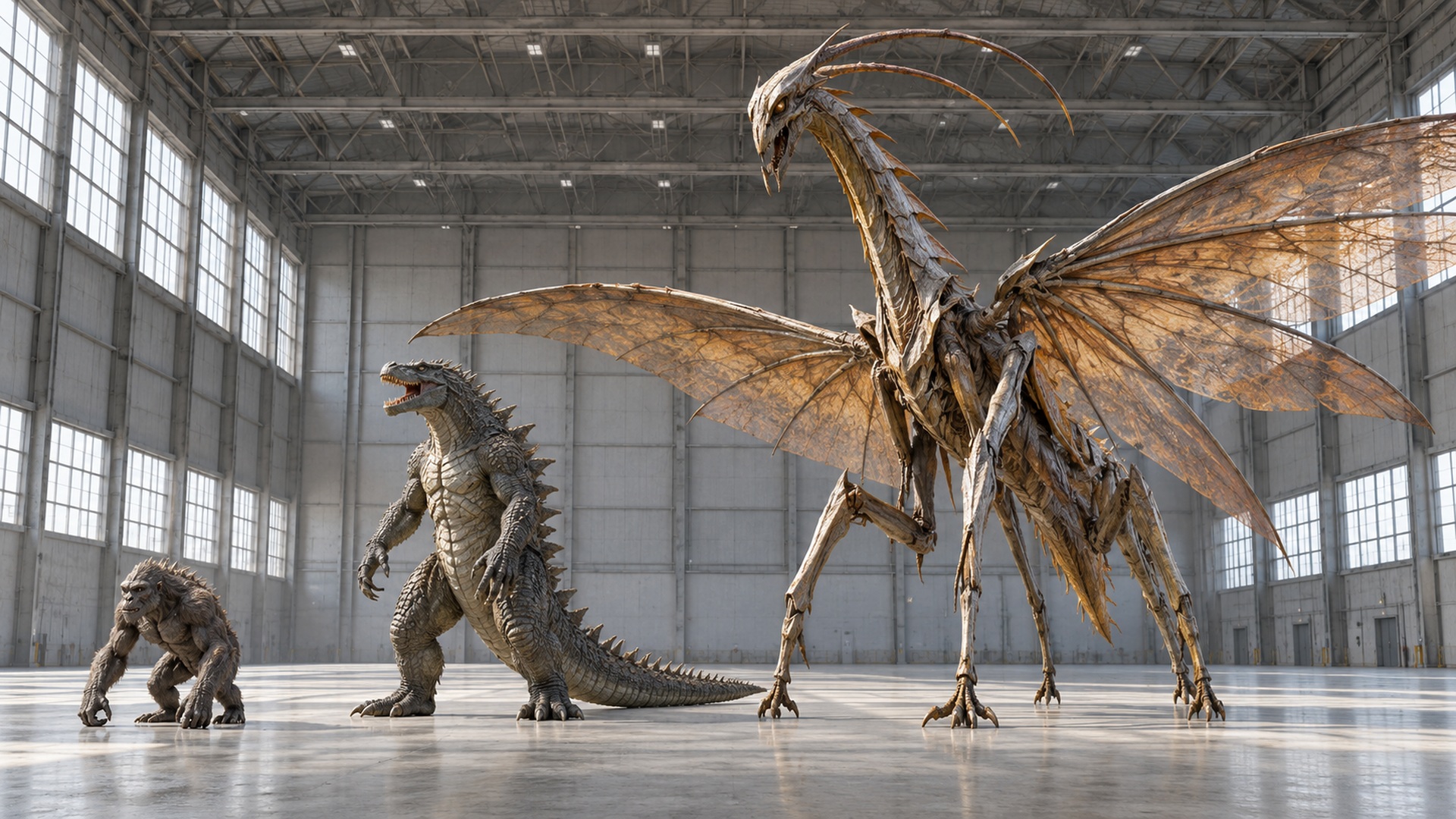
Godzilla, Kong, and Mothra Need Different Measuring Lines
The original Godzilla stands about 50 meters tall, while the anime trilogy’s Godzilla Earth reaches roughly 300 meters. Kong’s scale also changes substantially: production interviews describe the Skull Island creature at around 100 feet tall and the later Godzilla vs. Kong version at around 350 feet. Mothra makes the comparison more interesting because her most imposing dimension is a spread wingspan, not a towering upright body. These differences are large enough to change how a street, ship, or skyline looks beside each creature. The comparison below identifies the production and dimension behind each figure, then shows what the numbers mean when placed on common ground. Approximate production descriptions stay approximate, and a character’s height is kept separate from the area occupied by wings or a long tail. That gives us actual comparisons without making every familiar monster fit an inappropriate tallest-to-shortest ranking.
A: Use the figure for the identified incarnation or film rather than an unlabeled franchise maximum.
A: The approximate 100-foot and 350-foot figures imply a three-and-a-half-fold difference; both remain rounded descriptions.
A: It lists an 803-foot wingspan and a 52-foot body height, approximately 245 meters and 16 meters respectively.
A: No. Thickness, body proportions, density, and source specifications also matter.
A: Usually it is promotional composition rather than a consistent spatial record.
A: They may cover different incarnations, forms, or summary scopes.
A: Use restrained rounding that does not imply more certainty than the original figure.
A: A frame needs perspective analysis and contextual support before it can justify that conclusion.
A: The cited 521-foot and 393-foot values differ by 128 feet, approximately 39 meters.
A: Identify the version, the measured dimension, and the supporting evidence.
A Quick Comparison of Named Screen Versions
These figures come from Toho’s original-era Monsterpedia profile, the official Godzilla anime creature description, film-production interviews, and the 2019 Monarch promotional profiles. The two Kong figures are rounded descriptions used in production coverage, not claims of exact surveyed anatomy. Feet are converted to meters for convenient comparison.
| Creature and production | Dimension | Approximate size |
|---|---|---|
| Godzilla, original 1954 incarnation | Standing height | 50 m / 164 ft |
| Kong, Kong: Skull Island (2017) | Production-described height | 30 m / 100 ft |
| Kong, Godzilla vs. Kong (2021) | Rounded production description | 107 m / 350 ft |
| Godzilla, King of the Monsters (2019) | Standing height | 120 m / 393 ft |
| King Ghidorah, King of the Monsters (2019) | Standing height | 159 m / 521 ft |
| Mothra, King of the Monsters (2019) | Spread wingspan | 245 m / 803 ft |
| Mothra, same promotional profile | Body height | 16 m / 52 ft |
| Godzilla Earth, anime trilogy | Standing height | 300 m / 984 ft |
The important first result is that a familiar name can occupy very different scales. The second is that Mothra’s wide silhouette does not mean her central body stands nearly 245 meters high. Read the dimension column before comparing any two entries. A wingspan placed beside standing height is a useful contrast between body plans, but it is not one shared anatomical ranking.
Godzilla Provides a Clear Worked Example
The official profile for Godzilla’s original era gives a height of 50 meters, approximately 164 feet. The official anime trilogy creature page describes Godzilla Earth at 300 meters in height. Within those stated dimensions, the latter is six times as tall. That is a comparison between specified fictional presentations, not a statement that every Godzilla grows from one size into the other.
The difference becomes more dramatic when represented honestly. On a common vertical scale, a 50-meter silhouette reaches only one-sixth of a 300-meter reference height. The smaller creature does not cease to be enormous next to a person, but it occupies a very different relationship to the larger one. A cropped poster can conceal that distinction by giving each design an equally imposing share of its own frame.
Height ratios also should not be mistaken for mass ratios. Six times the height would imply 216 times the volume only for geometrically similar bodies with every dimension scaled equally. These fictional designs are not guaranteed to satisfy that condition, and their published masses follow their own source material. The numerical example explains a geometric relationship; it does not authorize inventing an official weight.
Kong Grows From Island Giant to Titan Opponent
Ian Failes’s 2017 Cartoon Brew interview with Industrial Light & Magic animation supervisor Scott Benza describes the Skull Island Kong as a roughly 100-foot creature. That is about 30 meters: enormous beside people, but below the original Godzilla’s 50-meter reference height. It is also far below the Kong prepared to confront a modern MonsterVerse Godzilla. The same recognizable face and hands do not imply the same body dimensions.
Aaron Sagers’s 2021 production report and interviews for Godzilla vs. Kong describe Kong at about 350 feet, or 107 meters. Using those rounded production descriptions, the later creature is about three and a half times as tall as the Skull Island version. The films also place decades between the island adventure and the later conflict, so growth belongs to the story. In the aircraft-carrier encounter, the larger Kong can share the frame with Godzilla as a plausible physical opponent rather than an animal whose entire body would reach only partway up his rival. A crouched pose still changes his visible height, so an illustration should state whether he is standing upright.
Mothra Spreads Wide Rather Than Standing Tall
The Monarch promotional profile prepared for Godzilla: King of the Monsters lists Mothra with an 803-foot wingspan and a 52-foot body height. Those convert to approximately 245 meters across the wings and 16 meters in body height. The difference is the point: her lateral extent is roughly fifteen times the profile’s vertical body dimension. A compact central body can occupy an enormous area when its wings open.
Compared with the same film’s roughly 120-meter Godzilla, the spread is about twice his standing height, while Mothra’s listed body height is only a small fraction of it. That does not establish that she contains twice as much material or weighs more.
Her silhouette distributes its area across wings rather than a thick upright trunk, and a folded pose changes the occupied width substantially. Use two views when imagining her beside a street or doorway: the full spread explains the sky-filling impression, while the central body explains what is actually close to the ground.
These numbers belong to the 2019 promotional incarnation. Toho’s general Mothra page groups multiple appearances and forms, so its summary statistics should not replace this film’s wingspan. Likewise, a larva’s long crawling body needs its own entry. Metamorphosis changes the geometry, rather than merely increasing one measurement on an otherwise identical animal.
Height, Length, Reach, and Mass Answer Different Questions
Height usually means a vertical extent from a defined baseline, but even that needs a convention. Does the measurement reach the top of the skull, a horn, a dorsal fin, or a raised antenna? Length can mean the straight distance between endpoints or a distance following a curved body. A serpent measured along its spine is not being measured in the same way as a standing creature’s vertical silhouette.
Reach deserves its own label. Extended tentacles, a striking neck, or outstretched arms can threaten space beyond the central body’s dimensions. That can make a creature formidable in an encounter without making its torso larger. Keeping reach separate helps explain why a smaller-bodied monster might dominate a scene through appendages or movement rather than through height alone.
Mass is another category entirely. Two creatures with equal height can differ greatly in thickness, density, armor, and internal structure. A skeletal flyer and a heavily built terrestrial beast should not receive the same estimated mass because their heads align on a chart. When an official mass is unavailable, the honest entry is an identified estimate with assumptions or an explicit absence of data.
Give Every Creature the Same Ground and Units
A common baseline is essential for a visual comparison. Feet should meet the same ground plane unless the chart clearly explains another convention. Floating silhouettes, uneven camera angles, or a tail used as an invisible support can make one creature appear taller without changing its stated measurement. The eye trusts alignment quickly, so a small layout inconsistency can distort the entire result.
Units need equal care. Meters and feet can be converted consistently, but rounded source figures should not acquire spurious precision during conversion. Fifty meters is about 164 feet for ordinary comparison purposes. Writing a long string of decimal places would imply a level of physical exactness that a fictional design specification rarely supports. Consistent rounding makes a chart clearer and more candid.
Read a Frame as Evidence With Conditions
A film image can help estimate scale when the environment contains a reliable reference, but perspective must be considered. An object closer to the camera appears larger, and the tops and bottoms of compared objects may occupy different depths. A creature and a building sharing a frame do not necessarily stand beside each other. Without that spatial relationship, measuring pixels gives a ratio of image sizes rather than a dependable ratio of real dimensions.
Effects production adds further complications. Composites can combine separately filmed elements, and a dramatic shot may favor visual impact over strict consistency. Miniatures, digital assets, lens choices, and editorial changes all influence the result. These tools are part of filmmaking rather than evidence of a failure, but they limit how confidently one shot can override a clearly identified reference specification.
A strong visual estimate uses more than one view, reports its assumptions, and gives an uncertainty range when appropriate. It identifies the reference object, considers camera position, and avoids treating decorative poster art as a survey. If different shots imply different scales, that inconsistency belongs in the explanation. Averaging incompatible images does not automatically produce a more accurate creature.
King Ghidorah Adds Height and a Wider Threat
Mike Seymour’s 2019 fxguide production coverage, featuring visual-effects supervisor Guillaume Rocheron, gives King Ghidorah a height of 521 feet, about 159 meters. The same report gives Godzilla 393 feet, approximately 120 meters. Subtracting the stated feet leaves a difference of 128 feet, or about 39 meters. Ghidorah is therefore around one-third taller under those reported conventions, rather than twice Godzilla’s height.
His visual dominance also comes from anatomy that the height line does not summarize. Three long necks distribute attention across the scene, and wings extend the threat beyond the central trunk. In a comparison drawing, aligning the feet helps explain the height advantage, while showing the wings separately explains why his occupied space can feel much greater. Combining those features into one unlabeled size number would hide the body plan that makes him distinctive. The scene can make him seem overwhelming without requiring the viewer to invent another hundred meters of height.
Put the Numbers Beside an Ordinary Skyline
Use a hypothetical 100-meter building as a common vertical reference. The original 50-meter Godzilla would reach halfway up its height; the production-described 30-meter Skull Island Kong would reach roughly three-tenths. The 107-meter description of the later Kong puts him just above the reference roofline. This is an illustrative building with a specified height, so the comparison does not depend on recognizing a famous landmark or guessing its dimensions from a photograph.
The 2019 Godzilla would extend about 20 meters above that roof, while Ghidorah’s reported height would extend about 59 meters above it. Godzilla Earth would rise to three times the building’s height. Spread Mothra’s wings horizontally beside the same reference and they cover roughly two and a half building-heights laid end to end. That last comparison describes width against a familiar length; it does not put her central body atop a 245-meter pedestal.
This scene gives each creature a different relationship with a place. Some look over the roof, some remain below it, and one fills the air across a broad lateral span. The figures answer the reader’s immediate question before posture and perspective complicate an individual shot. They also show why a monster can remain enormous at human scale even when another version stands several times taller.
What a Good Size Chart Ultimately Reveals
A well-made monster comparison reveals the choices behind the creatures. Godzilla’s changing incarnations show how familiar identities adapt to different worlds, Kong highlights the importance of posture and production context, and Mothra demonstrates why wingspan and life stage deserve separate attention. These are more revealing differences than an unexplained sequence of increasingly tall silhouettes.
The essential habit is simple: name the version, name the dimension, and name the evidence. Keep missing data visible and distinguish published specifications from visual interpretation. Once those foundations are secure, the imagination can supply all the awe it wants. Famous monsters become easier to compare without becoming less extraordinary.