The Sound Has No Visible Worker
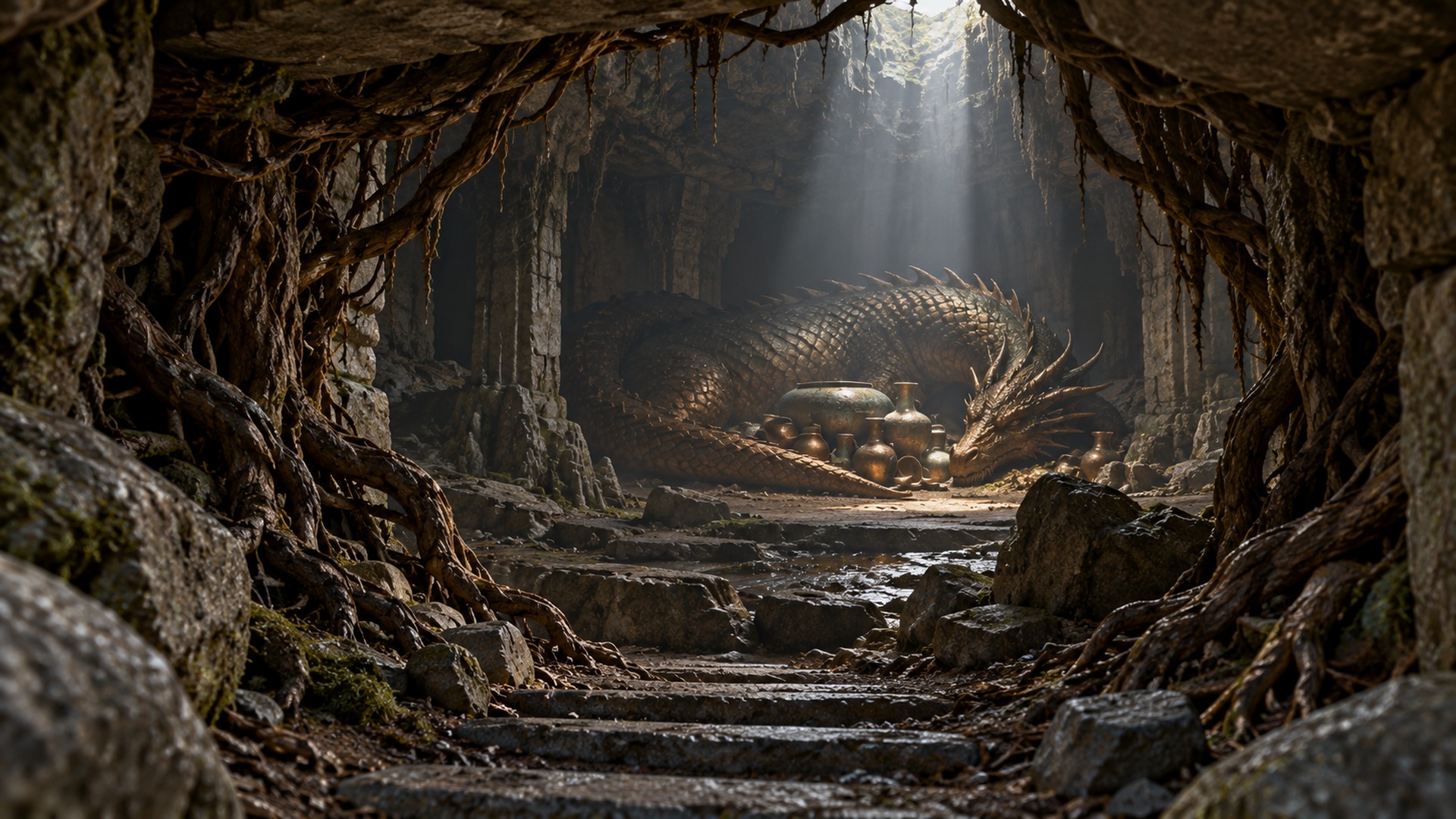
A knock travels through a mine where the person hearing it cannot see anyone working nearby. In a story, that sound may belong to another kind of resident: a helper, warning presence, troublesome neighbor, or owner of the space being entered. Underground traditions often give unseen places more than a frightening animal. They supply names, customs, occupations, and relationships with people above. The examples here come from particular collections and mythic texts, rather than a claim that one species lives beneath every landscape. Some of these beings are not monsters in the hostile sense at all. That distinction matters. A mine spirit connected with work and reciprocity has a different role from a fictional predator, while hidden neighbors associated with rocks and hills need not inhabit the same imagined world as a dragon guarding treasure.
A: William Evans sees silent fairy coal work where he knows no ordinary mine exists, in the account Sikes retells from Jones.
A: Food sharing can organize reciprocity and conduct within the encounter.
A: After insults and refusing a requested food share, continuing bad luck drives him away in the recorded tale.
A: Traditions can include helpers, craftspeople, neighbors, and ambiguous presences.
A: It preserves selected accounts and the collector's presentation of them.
A: The 1864 Powell and Magnússon selection from Jón Árnason, including The Genesis of the Hid-folk.
A: The source may organize contact through a boundary rather than continuous geography.
A: It gives mythic dwarf craft an actual process and conflict, distinct from the work of mine spirits.
A: Identify it as an invention inspired by sources rather than an unchanged traditional being.
A: They imagine unseen places as occupied spaces with relationships to the visible world.
Welsh Coblynau: Small Workers With Picks and Lamps
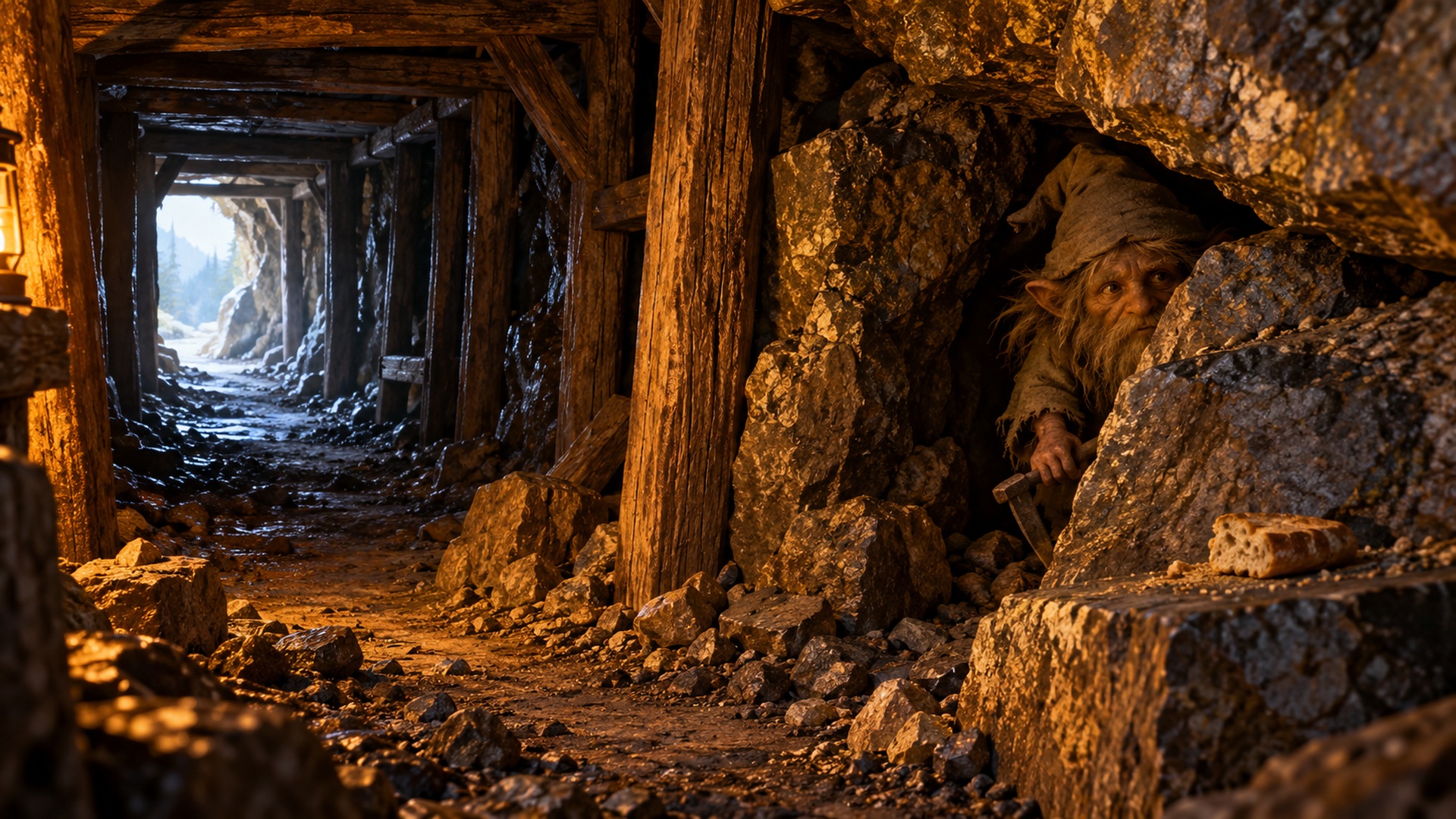
Wirt Sikes’s British Goblins (1880) describes coblynau as small figures associated with Welsh mines, dressed in an imitation of miners’ clothing and carrying little tools and lamps. Knocking can point toward ore, while their apparent work mirrors the work people perform underground. Sikes portrays them as generally friendly to miners, though disrespect can anger them. This is a collector’s presentation of particular traditions, not a biological description or an account of every Welsh community.
Sikes also retells an account from Edmund Jones in which William Evans crosses Beacon Mountain early in the morning and sees a fairy coal mine. Figures cut and carry coal and load horses in complete silence, although Evans knows no ordinary mine exists there. The encounter gives the hidden workers an organized place of their own. It is more specific than hearing an unexplained bang: an entire familiar occupation appears where the landscape should not contain it.
The contrast between visible labor and silence makes that version memorable. Tools, loads, and movement are recognizable, but the missing ordinary mine and missing work noise prevent the scene from fitting everyday experience. Coblynau therefore need not be recast as predatory cave animals to belong in an underground-being survey. Their significance comes from a relationship with work, skill, and access to resources. The particular telling should remain attached to Sikes and his cited source rather than becoming a universal rule about unseen mine residents.
Cornish Knockers: Tom Trevorrow Refuses to Share
Margaret Ann Courtney’s Cornish Feasts and Folk-lore (1890) records knockers associated with tin mines and repeats a Tom Trevorrow story credited to William Bottrell. Tom hears the beings, rudely tells them to leave, and is frightened by falling stones. Later, small voices ask for part of his food, but he eats it all. Persistent bad luck follows until he leaves the mine. The sequence makes the encounter about conduct toward an unseen presence rather than an unprovoked predator attack. Courtney also records knocking as a possible indication of useful ore, so assistance and retaliation belong to the same wider repertoire. These Cornish accounts should remain separate from Sikes’s Welsh descriptions even where mining, small workers, and knocking invite comparison. The food-sharing episode gives a particularly clear narrative hinge: an ordinary meal becomes an opportunity to acknowledge another resident, and refusal changes the relationship. Courtney’s surrounding material also contains prejudiced religious explanations characteristic of some older collections. Those claims should be recognized as part of the source’s historical framing, rather than adopted as the identity or origin of an actual community. This is a recorded folklore account, not a factual instruction for working underground or evidence that a missed offering causes accidents.
Icelandic Hidden Folk: The Children Kept From View
Jón Árnason’s Icelandic Legends, in George E. J. Powell and Eiríkur Magnússon’s 1864 English selection, begins its elf material with The Genesis of the Hid-folk. Eve conceals children she has not yet washed when God visits. The concealed children become hidden from human sight and dwell in hills, mounds, and rocks. The tale explains hidden neighbors through a Christian origin story rather than by describing a new species discovered in a tunnel.
The key contrast is visibility, not a measured distance beneath the surface. The beings belong to familiar features of the landscape yet are not ordinarily available to human view. Their relation to people is also genealogical in this particular story: separation follows concealment within a shared family origin. That does not make the account the single explanation offered by all Icelandic traditions. It identifies one text and its narrative mechanism. The translators themselves acknowledge selection and adaptation, so their edition is a particular English presentation. Even with that brief qualification, the story gives the reader an actual event to remember rather than merely an assurance that hidden-people stories exist.
Norse Dwarfs: Brok, Sindre, and the Short Hammer Handle
In Rasmus B. Anderson’s English Younger Edda, first issued in 1879 and presented in a 1901 edition, the making of divine treasures supplies a concrete dwarf-craft story. After Loki damages Sif’s hair, crafted replacements and other gifts become part of a wager. Brok and his brother Sindre work at a forge, where keeping the bellows moving is essential to the result. Anderson uses these name spellings; other translations commonly render them differently.
A biting fly repeatedly interferes with Brok’s work. He persists through the first attempts, but an interruption during the hammer’s making leaves its handle short. The completed gifts are judged, and Thor’s hammer is declared especially valuable despite that feature. The story gives craft a process: materials enter the furnace, one worker controls the bellows, another makes the object, and disruption has a visible consequence.
These mythic craftspeople are not interchangeable with mining helpers. Their workshop produces objects sought by gods, and their agency includes skill, bargaining, and competition. Nor does this episode provide a surveyed floor plan locating every Norse dwarf in one literal underground kingdom. Its relevance is the mythic association of concealed craft and extraordinary objects, alongside other Eddic descriptions connecting dwarfs with earth and stone. Naming the episode and edition lets the comparison retain that role without importing a standardized modern fantasy society into the older text.
Names Carry More Than a Convenient Creature Label
A local name can connect a being with language, place, and a body of stories. Replacing it immediately with goblin or monster may make a list easier to scan while making the account less accurate. Translations can be useful, but their limits should remain visible. A broad English term does not establish that several traditions describe one thing.
The same caution applies to etymology. Similar-looking names do not by themselves prove a historical relationship or a precise original meaning. Those are questions for linguistic evidence. An article can discuss the recorded beings clearly without inventing a confident origin story for every word.
Underground Occupation Can Resemble Human Work
Mining spirits often become memorable through activities resembling those of the people who tell the stories. Tools, work clothes, meals, and knocks place them in an intelligible setting. The extraordinary resident does something recognizable. That makes the unknown space feel occupied rather than merely empty.
This can support both reassurance and unease. Another worker may appear helpful, but an unseen occupant can also imply that humans are not fully in control of the place. The relationship depends on the particular account. A comparison should describe that ambiguity instead of deciding in advance that every underground being must be either friendly or malicious.
For modern readers, these details are often more revealing than size or appearance. A rule about sharing food says something about the imagined encounter. A description of a pointed ear may tell much less unless the source gives it a role. Folklore is not only a catalog of bodies; it is also a record of actions and relationships.
Hidden Habitation Is Not the Same as Physical Depth
A community said to inhabit a hill can be conceptually near while remaining inaccessible. Its significance need not depend on a measured distance below ground. A mine, by contrast, is a human working environment with actual passages and entrances. Both can appear in discussions of what lies beneath us, but their spatial logic differs.
Keeping that distinction clear prevents a modern map from flattening several imaginative worlds into one tunnel network. Stories may locate an encounter at a rock, entrance, or boundary without describing continuous geography beyond it. Absence of a complete map is not a gap that the article needs to fill. It can be part of how the tradition presents hidden space.
Fear Is Only One Possible Relationship With the Unseen
These examples include work, exchange, assistance, and boundaries alongside possible danger. A being can be treated with caution without being an enemy. A story may warn against disrespect rather than against entering any underground space at all. Reading for those relationships keeps the account from becoming a modern horror summary imposed on every tradition. It also makes the frightening moments more specific because the reader understands which expectation or relationship has been disturbed.
Modern Cryptid Retellings Change the Evidential Claim
A collected legend and a modern claim about an undiscovered animal are different kinds of statement. The first can be studied through versions, tellers, and cultural setting. The second makes a claim about a physical organism. Transferring a traditional name into a cryptid account does not supply biological evidence.
That transfer may also change the being’s role. A reciprocal relationship with hidden neighbors can become a report about a secret population, losing the original story’s conduct and social meaning. Readers should notice when that change occurs. The newer version can be identified and discussed without being presented as the inevitable or original meaning of the older one.
This distinction leaves room for imaginative adaptation. Writers can create new underground creatures inspired by several traditions. They should label the result as an original invention rather than claim that every source already described the same modern monster. Clear attribution helps preserve both the folklore and the creativity of the adaptation.
Read for the Encounter the Story Organizes
Ask who enters the space, what the resident does, and what behavior matters afterward. A knock leading toward work, a meal left for a hidden presence, and an exchange with unseen neighbors organize different encounters. These details explain why a particular being belongs to its narrative. They also help distinguish stories that look similar when reduced to one sentence.
The underground becomes more interesting when those differences remain visible. It can be a workplace shared with unseen figures, a landscape with hidden neighbors, or a mythic location of craft. None requires all other versions to disappear. The variety is what gives the question of what lies beneath us its lasting imaginative range.
The Earth in Folklore Is Often Inhabited, Not Empty
The common thread is not a single universal monster. It is the possibility that places beyond ordinary sight already belong to someone or something. That possibility changes how an entrance, rock, or unexpected sound is interpreted. A reader who follows the particular names and sources finds a richer world than a list of cave predators: one in which fear, work, reciprocity, skill, and neighborly boundaries can all shape the unseen side of a familiar landscape.