A Small Entrance Can Conceal an Entire Other World
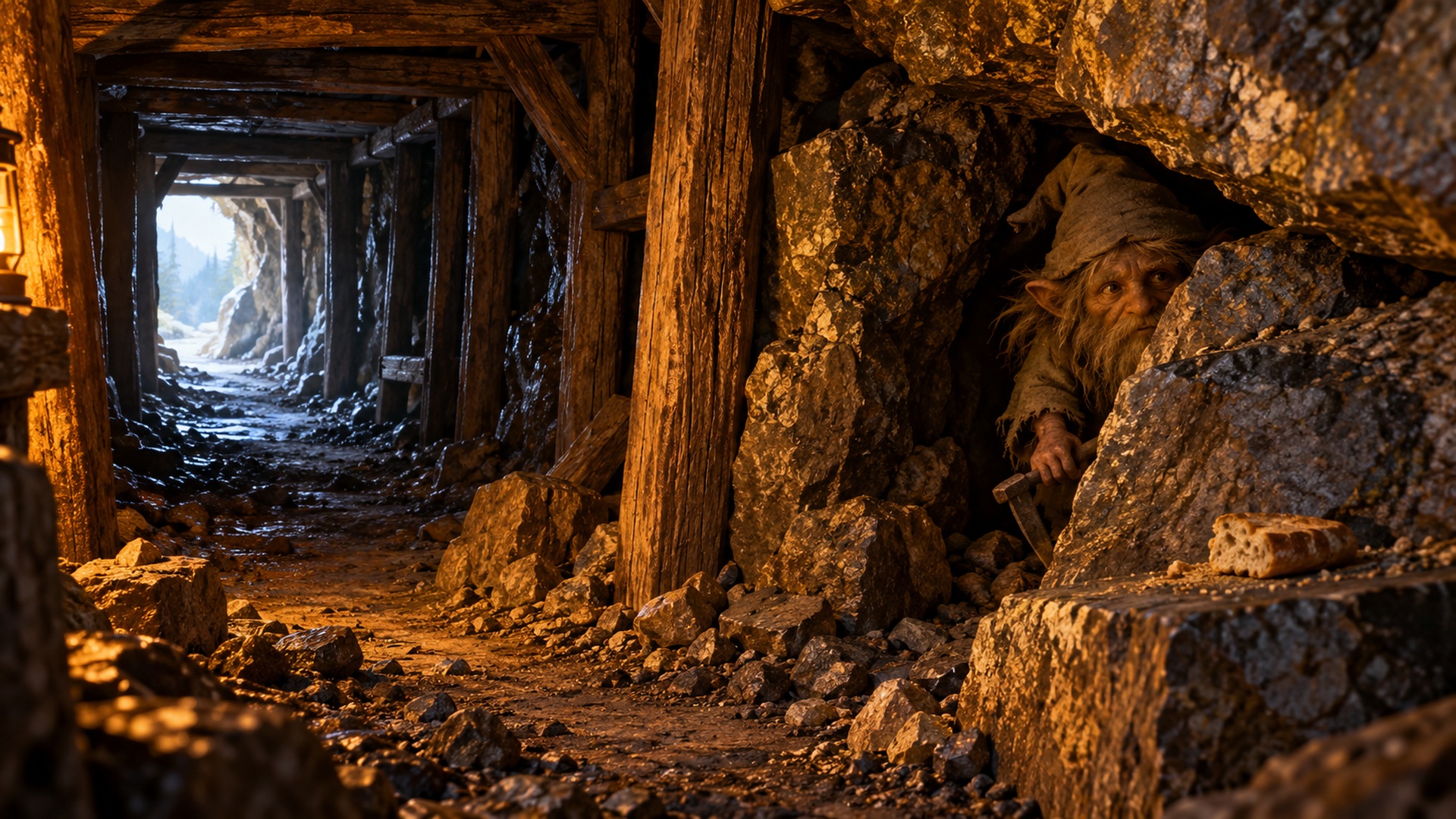
The opening looks too modest to explain the sound coming from within. Beyond it, a passage descends out of sight, leaving the visitor unable to judge the chamber’s size or the distance to its occupant. Underground lairs make that mismatch between visible entrance and hidden extent part of the encounter. Yet the most memorable examples do more than place a monster in darkness. A dragon’s barrow connects protection with treasure and memory; an industrial underworld connects a hidden population with life above; a chamber beneath a familiar house can turn descent into a discovery about the past. The following literary and mythic examples are different kinds of imagined place. Comparing their layouts and narrative purposes reveals why the lair can be as important to the fear as the creature that lives there.
A: The dragon's barrow, the Morlocks' underworld, Exham Priory's buried chambers, and Gollum's underground lake.
A: The relationship among the barrow, hoard, occupant, and intrusion shapes the narrative.
A: A guarded hoard and a hidden industrial population create different relationships with the surface.
A: Concealed spaces connect the ancestral building with a disturbing hidden history.
A: Its ancient accounts do not uniformly establish an underground location, though difficult return is central to its role.
A: It lets later understanding preserve and explain an earlier clue.
A: Different premises can establish different requirements if the distinction is clear.
A: Their position beneath an ancestral residence lets discovery overturn the narrator's understanding of his inheritance.
A: Similar spaces can belong to different cultural contexts and narrative roles.
A: It can change how the reader understands the familiar world above.
Beowulf: One Stolen Cup Opens the Barrow to the World
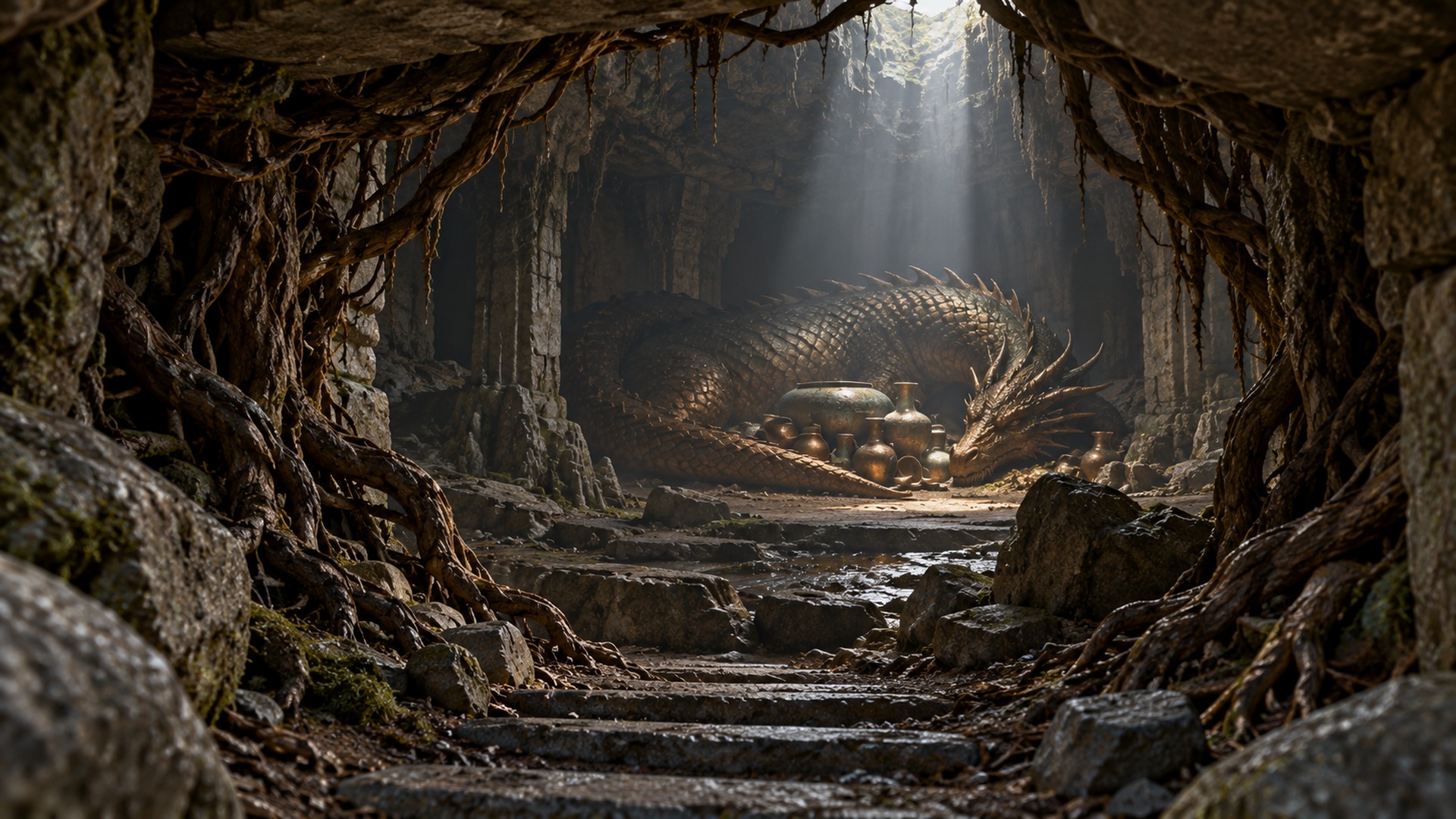
In the dragon episode of Beowulf, a treasure-filled barrow stands in a landscape with a history older than the current encounter. A fugitive enters and removes a cup from the hoard. The dragon discovers the loss, searches for the intruder, and carries its anger outside. A small object therefore links the enclosed chamber with the vulnerable settlements beyond it. The lair is not an isolated arena waiting for a hero; it already has contents, a guardian, and a boundary whose violation changes the surrounding world.
The treasure matters because it connects possession with the remains of an earlier human community. Objects that once had social uses lie gathered outside ordinary circulation. The dragon guards accumulated wealth rather than using it as people would. This makes the chamber feel temporally deep as well as physically enclosed. The visitor encounters a place where the past has become inaccessible property, and the theft brings that arrangement into conflict with the present.
For Beowulf, approaching the barrow is consequently different from meeting a roaming animal on open ground. The entrance concentrates the encounter at a known boundary, while the hoard explains why the creature occupies that particular place. Frederick B. Gummere’s English translation makes the sequence available as a connected episode: entry, missing object, outward devastation, and the eventual confrontation. The relationship among those actions gives the lair its identity. Removing the cup or replacing the hoard with an empty floor would change the causal structure, even if the dragon and the darkness remained.
The Time Machine: The Surface Depends on What Lies Below
H. G. Wells’s The Time Machine (1895) first lets the Time Traveller mistake the visible future for a relatively simple world. The Eloi live above ground, while openings, ventilation, and machinery point toward another arrangement beneath them. When he descends a shaft, the Morlocks’ world replaces that first impression with a hidden industrial population. His visit is constrained by darkness, unfamiliar movement, and the limited protection offered by matches. The descent is an investigation whose conditions he cannot fully control.
The underground is therefore larger in purpose than one monster’s bedroom. It is a system connected to the surface, and learning about it changes how the Eloi are understood. The Traveller’s explanations also develop over time; his early theory should not be treated as an omniscient description supplied before the visit. Later revelations make the relationship more threatening. The White Sphinx and the disappearance of his machine give him a practical reason to remain involved when withdrawal would otherwise be attractive. Access, machinery, and the object needed for escape connect separate spaces into one plot. Unlike Beowulf’s guarded store, this lair is frightening because the pleasant-looking world above has concealed dependencies. The visitor does not merely find a dangerous resident. He discovers that his original account of the whole landscape was inadequate.
The Rats in the Walls: The House Rests on an Unwanted History
H. P. Lovecraft’s The Rats in the Walls, first published in 1924, begins with the restoration of Exham Priory as an ancestral residence. The narrator wants to recover a family place, but the building’s layered foundations and the apparent movement of rats point toward something beneath that restoration. A search eventually carries an expedition below the familiar structure into concealed chambers. Descent turns the effort to reclaim heritage into an encounter with what that heritage has hidden.
The important layout is vertical and historical. A reconstructed upper house does not erase earlier foundations, and the deeper spaces expose a past incompatible with the narrator’s desired identity. The underground discovery includes evidence of horrific treatment of human beings; the story’s conclusion is disturbing without requiring a detailed catalogue here. It is not simply a cave in which a conveniently unrelated beast happens to sleep. The site connects the narrator’s family claim with the very history he is unprepared to accept.
This makes Exham Priory a different kind of monster lair from the dragon’s barrow. The horror does not remain safely assigned to an external guardian. The narrator’s relationship to the place becomes part of the threat, and the account’s final instability prevents a comfortable separation between investigator and discovered evil. The rats initially seem to promise an identifiable source for a sound. The descent instead enlarges the problem until the restored house itself has acquired another meaning. Moving the same events into an anonymous cave would weaken that reversal: the ancestral building above is essential to what the hidden chambers reveal.
The Hobbit: Gollum’s Lake Makes an Encounter Into a Contest
In J. R. R. Tolkien’s The Hobbit (1937), Bilbo reaches a dark underground lake where Gollum lives on an island. The water separates the visitor’s route from the resident’s home and lets Gollum approach by boat. Their riddle contest turns the chance meeting into a precarious agreement about what happens next. The small lost ring adds another relationship between the visitor, the resident, and the route out.
The geography keeps the scene intimate. Bilbo cannot read the whole interior or assume that his opponent’s knowledge matches his own. A lake, island, shore, and passage create several practical boundaries without requiring an endless maze. Gollum is threatening partly because this is familiar territory to him and a poorly understood interruption to Bilbo. The underground setting changes what each participant knows and can do, rather than supplying darkness as decoration.
The Minotaur Is a Comparison, Not an Unqualified Underground Entry
Classical sources associate the Minotaur with the labyrinth built by Daedalus, but that does not make every ancient account an explicit subterranean setting. Its central spatial problem is confused passage and difficult return. Later underground images can be evocative while remaining particular adaptations. Keeping the qualification brief prevents the labyrinth from carrying a claim it does not consistently support. It still illuminates a useful contrast: Gollum’s lake can constrain an encounter through a few clear boundaries, while the labyrinth threatens the ability to understand and retrace a route.
Entrances Link the Resident to a Reason for Entering
Each main example gives the visitor something more specific than curiosity about a dark hole. The missing cup connects an intruder to the dragon’s hoard. The Time Traveller needs to understand the Morlocks and recover the means of departure. Exham Priory’s narrator follows signs beneath a building he claims as his own. Bilbo needs a route through a place in which he has become lost. Those purposes make retreat consequential.
The same distinction explains why their thresholds are not interchangeable. The barrow marks guarded possession, a shaft leads into a hidden social arrangement, and the priory’s descent compromises a familiar inheritance. At the underground lake, water divides the resident’s secure position from the stranger’s uncertain route. Entry changes a relationship in each case. It does more than reduce the light level.
Objects Make the Hidden Interior Reach the Surface
The cup and the time machine have very different scales, yet each lets a concealed place affect what happens outside it. One loss provokes outward action; another traps a visitor in a future he is trying to leave. The objects give the lair consequences beyond the room where an encounter takes place. They also prevent the interior from feeling disconnected from the rest of the story.
At Exham Priory, the connection is less portable: the building itself rests on what is found below. The upper residence cannot retain its original meaning after the discovery. This is why the lair is part of the explanation rather than a bonus location added late in the narrative. The spatial relationship supports the thematic reversal.
These are readings of particular works, not one universal symbol for everything beneath the earth. A hoard, an industrial population, ancestral chambers, and an isolated lake organize different relationships. Treating them all as the same cave would erase the feature that makes each memorable. Their shared darkness is a starting condition, while their contents and connections do the distinctive work.
Getting Out Is a Different Problem From Getting In
The Time Traveller’s descent can be considered alongside his later recovery of the machine. An opening that seems to offer what he wants also exposes him to a situation arranged by inhabitants who know the place better. He needs more than the ability to find a shaft: he must retain access to the object that can remove him from the entire future landscape. This makes the underground episode part of a larger escape problem. The object changes what counts as an adequate exit. Simply reaching daylight would not complete his original purpose, because he would still be stranded in the world he has visited. The contrast with an ordinary cave exploration is useful. The Traveller is not collecting a map for its own sake; each discovery changes whether he can regain control over his journey.
The other examples make return difficult in different ways. In Beowulf, consequences have already escaped the barrow before the hero reaches its entrance. The confrontation cannot be reduced to stepping inside and then backing out without changing the surrounding crisis. At Exham Priory, the expedition’s knowledge compromises the idea of going upstairs to resume the earlier restored household. The discovery cannot be left behind as though it were an unrelated hazard in a distant room. These differences show why the route out deserves as much attention as the route down. A narrow passage can constrain bodies, but an object, obligation, or revelation can constrain the meaning of departure. That is how an underground setting continues to shape the story after its layout has become clearer. The reader remembers what the visitor needed, what the interior changed, and why an apparently simple return no longer restores the starting situation.
The Most Memorable Lair Changes What the Visitor Understands
By the end of each encounter, the underground has supplied information that the entrance alone could not disclose. The barrow connects guarded wealth with destruction outside; the Morlocks revise the surface world’s apparent simplicity. Exham Priory turns inheritance against the inheritor, while Gollum’s lake makes local knowledge part of a dangerous negotiation. The lair matters because the scene would become a different event without it. Its routes, objects, and resident belong to the same narrative, and leaving the interior does not always restore the visitor’s earlier understanding of the world above.