One Lift Can Hide Several Different Strengths
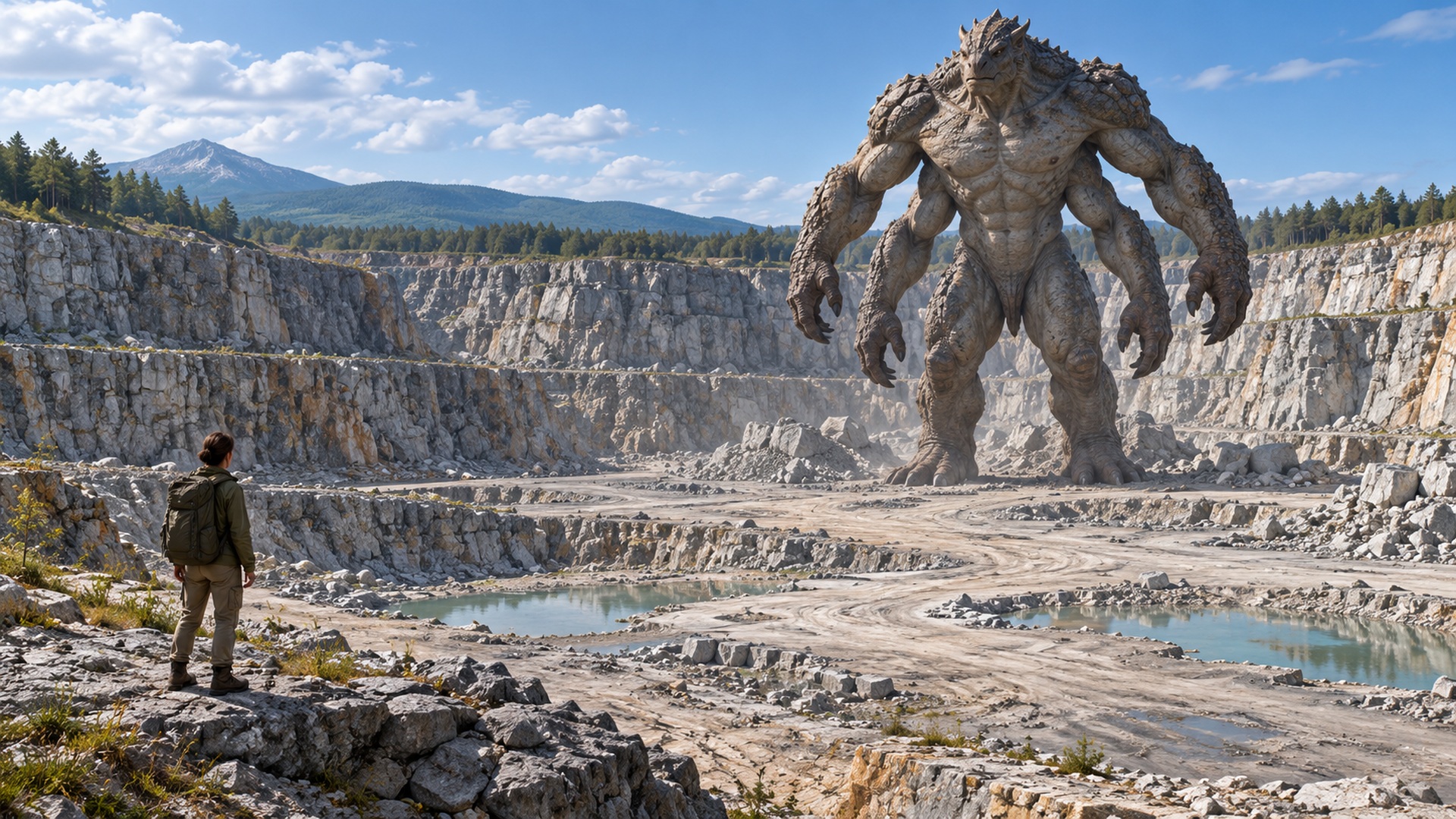
A monster hooks its hands beneath a vehicle and raises it as though the load barely matters. The image communicates superhuman strength immediately, but it leaves the mechanism unresolved. Did the creature generate enormous muscle force, gain an unusually favorable lever, or rely on a body heavy enough to stay planted while the vehicle moved? Those possibilities lead to different kinds of powerful animals. Lifting, dragging, crushing, striking, and jumping all involve force, yet they do not demand identical anatomy or performance. A creature that excels at one task may be limited in another. Exploring how strong a monster could really be therefore means following forces through the whole body, from contracting fibers to tendons, joints, feet, and ground. It also means separating a plausible extension of animal performance from an explicitly fictional power. Ordinary biology already produces remarkable feats, but giant size changes the costs as well as the benefits. The most convincing strong monster is one whose impressive action makes sense for the body performing it.
A: No. Muscle architecture, tissue properties, leverage, and the task all influence the result.
A: Absolute muscle force can rise while body mass increases faster under simple geometric enlargement.
A: That extrapolation ignores the structural and physiological changes caused by enlargement.
A: They could instead overload joints and attachments unless the supporting system also changed.
A: Usable traction is failing before the muscles' theoretical force capacity can be applied.
A: Sharp contact, speed, and impact mechanics can cause damage without equivalent lifting ability.
A: Stored energy is released rapidly after muscles loaded the elastic system over a longer interval.
A: Reducing external moment arms can lower the torque required at loaded joints.
A: Yes. A load moving without a plausible mechanical support path may imply a different force mechanism.
A: Show grip, posture, stable support, tissue tolerance, and the effort appropriate to the task.
Muscle Force Starts With Working Fibers
Skeletal muscle produces force through the collective action of many microscopic contractile units. At the level of a whole muscle, its physiological cross-sectional area is an important predictor of maximum force capacity. Broadly, more fibers arranged to pull in parallel can generate more force. The visible bulge of a limb is only an imperfect guide because muscles differ in fiber orientation, length, tendon arrangement, and the proportion of contractile tissue they contain.
Researchers distinguish muscle force from force delivered to an external object. Lomas S. Persad and colleagues’ 2024 Journal of Applied Physiology paper, Specific Tension of Human Muscle In Vivo: A Systematic Review, examines force per physiological cross-sectional area and explains why the estimate depends on measurement methods. A monster’s arm measurement alone cannot tell us what it can lift. A defensible estimate would need both the tissue’s capabilities and the mechanical arrangement transmitting its pull.
Enlargement Gives Absolute Strength and New Burdens
Consider a purely hypothetical animal enlarged without changing its proportions. If every linear dimension doubles, muscle cross-sectional areas increase fourfold while body volume increases eightfold. Assuming similar density and muscle properties, its absolute force capacity could increase while its force relative to body weight becomes less favorable. The larger animal may be stronger in an ordinary external task yet less able to perform acrobatics with its own body.
This is why an ant’s impressive load relative to its mass cannot simply be assigned to an ant the size of a house. A small animal’s proportions and operating conditions belong to its scale. Enlarging it would change structural loads, joint mechanics, respiratory demands, and the behavior of surfaces beneath its feet. A gigantic insect would need substantial redesign before its lifting performance could be discussed meaningfully.
Real animals do not remain perfect geometric copies across sizes. Their limbs, posture, muscle architecture, and movement strategies change. Andrew A. Biewener’s 2005 Journal of Experimental Biology review, Biomechanical Consequences of Scaling, describes how posture and musculoskeletal proportions help animals manage those loads. For monster design, the useful conclusion is conditional: greater size can increase total force, but retaining the same athletic style requires additional explanation.
Leverage Decides How Muscle Pull Becomes a Lift
Muscles act across joints through moment arms, producing rotational effects that depend on where their tendons pull. External loads also have moment arms relative to those joints. Holding a weight close to the body can be easier than holding the same weight at arm’s length because the external rotational demand changes. A creature may look dramatically stronger simply by arranging its body and its load more favorably.
Long limbs can increase reach and movement range, yet they can also increase the torque needed to control distant loads. A short, robust forelimb may favor forceful handling close to the torso, while an elongated limb may serve other tasks. There is no universally best shape for strength. The arrangement must be judged against the action: lifting a slab, pulling a branch, grappling an opponent, or swinging a weapon-sized appendage. Muscle architecture adds another tradeoff. Longer fibers can accommodate greater shortening distances, while packing fibers into a different arrangement can favor force within a given muscle volume. These features interact with tendon compliance and joint motion. A credible monster might therefore possess enormous close-range pulling ability without having equally extraordinary reach, speed, or fine control at the end of a long arm.
The Skeleton and Tendons Must Survive the Feat
Force is useful only if the structures transmitting it remain functional. A powerful contraction can load tendon attachments, joint surfaces, and bones as well as the object being moved. Stronger muscle alone could make injury more likely if the rest of the body were unchanged. A superhuman lifter needs a coordinated support system, including tissues that tolerate repeated stress and can repair the damage associated with ordinary use. Joint stability matters particularly when the load is awkward. A vehicle does not behave like a perfectly balanced gym weight, and an animal cannot assume every grip places forces along its strongest axis. Twisting, sudden shifts, and slipping contact can generate unexpected demands. A monster capable of handling such objects consistently would benefit from robust joints, effective sensory feedback, and movement patterns that keep unstable loads under control.
Traction Can Be the Real Limit
Consider an invented two-tonne creature pulling horizontally on level ground. For a deliberately simplified friction model, let its mass be 2,000 kilograms, gravitational acceleration 9.8 meters per second squared, and the effective coefficient of friction 0.4. Its weight supplies about 19,600 newtons of normal force, so the assumed friction limit is roughly 7,840 newtons. Muscles capable of a greater horizontal pull would still make the feet slide unless the animal changed the contact conditions. These are selected example values, not measured properties of a monster or a recommendation for handling a real load.
That calculation explains why moving a truck and lifting it are different feats. A wheeled vehicle may roll under a force far smaller than its weight, depending on its actual condition and surface, whereas raising the entire vehicle requires supporting that weight. An impressive-looking pull therefore cannot be converted directly into a lifting capacity. On soft soil, even the simple friction model becomes inadequate because the substrate can shear or the feet can sink. The same creature might succeed on firm ground and fail in mud without losing any muscle strength.
Balance adds a separate constraint when the creature lifts in front of its body. The combined center of mass moves toward the load, creating a tipping problem even if its limbs can supply the force. Drawing the object inward or changing the stance can reduce that demand, while bracing transfers forces into another structure that must also survive. A visible foot adjustment is consequently part of the feat, rather than incidental motion. It shows how the animal makes its available force usable.
A Powerful Blow Is Different From a Heavy Lift
A strike depends on the motion of an effective moving mass and on how that motion changes during contact. Speed, contact duration, striking surface, target deformation, and the body’s alignment all affect the forces produced. An animal that slowly supports a heavy load is demonstrating something different from one that accelerates a limb and transfers energy into an impact. Calling both actions strong does not make their mechanics interchangeable.
The striking body must also tolerate the reaction. A rigid club-like tail, a padded forelimb, and a narrow claw concentrate forces differently and face different injury risks. A broad surface may push or batter, whereas a sharp point can damage through high local pressure without requiring the greatest total force. Destructive appearance can therefore reveal a specialized contact design rather than extraordinary lifting capacity.
Explosive Action Requires Power and Recovery
Mechanical power describes how quickly work is performed. Raising a load slowly and launching it upward can require similar changes in gravitational energy while demanding very different rates of energy delivery. Muscle performance also depends on contraction conditions, so the highest force and highest shortening speed are not simply available together at will. A believable burst specialist has a different performance profile from a patient load-bearing animal.
Energy can sometimes be stored elastically and released rapidly, allowing an action to have a higher instantaneous power than the muscles supplied during loading. That is a legitimate biological strategy, but it does not create energy. The system must be charged, controlled, and protected from premature release. A fictional creature with an elastic striking apparatus might deliver one startling movement and then need time to reset.
Repeated feats bring metabolism into the explanation. Working muscles need energy supplies, circulation, and temperature control, while intense effort can fatigue the system. A monster that repeatedly hurls large objects without changing pace or showing recovery requirements needs a special premise beyond one powerful contraction. Its endurance, cooling capacity, and fuel availability are part of its strength story.
Grip and Coordination Make Strength Usable
Hands are not the only way to control a load. Jaws, claws, tusks, trunks, and whole-body braces can all transmit forces, but each limits what the creature can manipulate. A smooth object with no secure purchase may be hard to lift even for an animal with formidable muscles. Contact points must resist slipping and keep the load from rotating out of control.
Coordination becomes especially important during unfamiliar tasks. Sensory feedback helps an animal judge contact, position its joints, and adjust when an object shifts. A monster can be incredibly strong yet clumsy with delicate structures because their failure occurs before it recognizes the needed correction. That difference can make a character more distinctive than simply assigning it a very large lifting number.
Let Effort Leave Visible Evidence
The environment can help tell the strength story. Ground compressed beneath a foot, a grip adjusted before a lift, and a pause after a burst make the action feel connected to a physical world. These details do not require a lecture or an exact tonnage. They show that the creature recognizes resistance and responds to it. A character who changes posture when a load shifts appears more capable than one who ignores every consequence. For a fictional monster, that visible competence can make a feat feel more extraordinary because the audience understands what had to happen for it to succeed.
Where Superhuman Becomes Explicitly Supernatural
A small creature that casually lifts an enormous mass without bracing poses several linked problems. Its tissues must generate and transmit the necessary force, its stance must remain stable, and the supporting surface must bear the combined load. If the object rises despite no plausible support path, the scene may be implying levitation or another field-like effect. That can be a valid story choice, but it is a different mechanism from unusually strong muscles.
Other fictional solutions include altered gravity, exceptional biological materials, or an external energy source. Each should solve a defined problem while leaving its consequences consistent. Lowering an object’s effective weight would ease lifting without necessarily reducing its inertia during a rapid throw. A powerful energy supply could support sustained work but would not automatically protect joints from the forces that work produces.
For readers and creature designers, the best explanation follows the entire action. Identify the task, the load, the time involved, the contact points, and the route by which forces reach the environment. Then ask which part ordinary animal biology can plausibly extend and which part requires an invented rule. A monster feels powerfully real when its anatomy, movement, and surroundings all participate in the feat. Its strength becomes a characteristic with texture and limits, making the moments when it exceeds human capability more compelling.